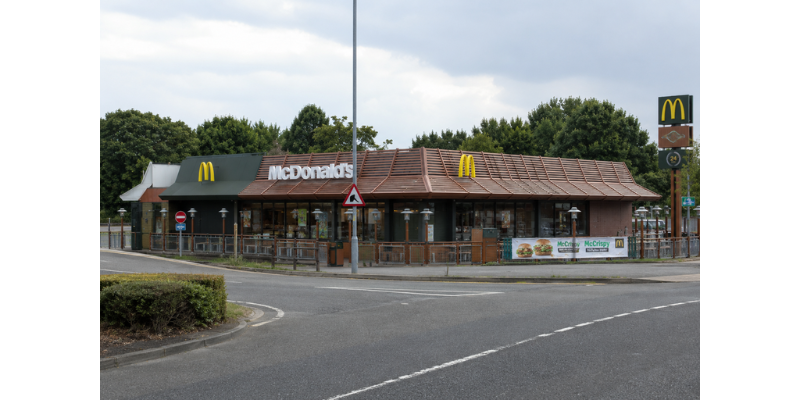
McDonald’s has lost its latest trademark dispute with Irish fast-food chain Supermac’s, after the UK Intellectual Property Office concluded that British consumers were unlikely to confuse the SUPERMAC’S name and logo with McDonald’s established trademarks.
The July 31, 2026 decision allows Supermac’s to move forward with its UK trademark applications, subject to any appeal. McDonald’s had relied on trademarks including McDONALD’S, McCAFE, BIG MAC and GRAND BIG MAC, arguing that Supermac’s proposed registrations created a likelihood of confusion and could benefit unfairly from the reputation McDonald’s had built over decades. The UKIPO accepted the strength of that reputation but rejected each ground of opposition.
The result draws a defined boundary around famous-mark enforcement. A company can establish substantial goodwill and consumer recognition without gaining exclusive rights over every name that shares part of its branding.
McDonald’s Trademark Rights Were Strong, but SUPERMAC’S Was Different Enough
Supermac’s filed its UK applications on April 14, 2021, seeking protection for the SUPERMAC’S word mark and a corresponding logo. The applications covered restaurant, fast-food, takeaway, self-service and related food-and-drink services. McDonald’s formally opposed the applications on December 17, 2021.
Its opposition relied on three areas of UK trademark law. McDonald’s argued there was a likelihood of consumer confusion, that SUPERMAC’S could unfairly benefit from or damage its trademarks’ reputation, and that use of the name could amount to passing off based on McDonald’s existing goodwill.
McDonald’s entered the dispute with substantial evidence behind its portfolio. The UKIPO recognized strong reputations in McDONALD’S, McCAFE and BIG MAC and found that extensive use had increased the distinctiveness of those marks. The problem was the distance between those established rights and the marks Supermac’s wanted to register.
The hearing officer found only a very low or low degree of visual similarity between SUPERMAC’S and McDONALD’S or McCAFE. BIG MAC presented a closer comparison, with medium visual and aural similarity, but the shared “MAC” element did not control how consumers would perceive the marks as a whole.
Words such as “SUPER,” “BIG” and “GRAND BIG,” along with their placement and the possessive ending in SUPERMAC’S, created enough separation. The UKIPO therefore found no likelihood that an average consumer would mistake Supermac’s for McDonald’s.
The McDonald’s “Family of Marks” Argument Could Not Extend Its Protection
McDonald’s also relied on the broader structure of its trademark portfolio. The argument was that consumers familiar with multiple Mc/Mac-related brands could encounter SUPERMAC’S and assume it belonged to the same commercial family.
That theory can matter when companies maintain portfolios built around a recognizable naming pattern. A consumer does not need to believe two trademarks are identical. Confusion can also arise when the later mark appears to be a new product line, subsidiary or brand extension from the owner of the earlier marks.
The UKIPO did not find that relationship here. The claimed common element appeared differently across McDonald’s marks, and the evidence did not establish the type of consistent market presence needed to make SUPERMAC’S appear to consumers as another member of the same trademark family.
The ruling exposes a portfolio-management issue that extends beyond the restaurant industry. Registering numerous marks containing similar prefixes, suffixes or words does not necessarily create enforceable ownership of the underlying naming formula. A company seeking broader protection from a family of marks needs evidence that consumers actually recognize the repeated element as indicating a common commercial source.
McDonald’s portfolio remains exceptionally valuable. The decision nevertheless shows that the strength of individual trademarks and the enforceable reach of an entire naming system are separate questions.
Consumer Association Was Not Enough to Establish Trademark Confusion
The more consequential part of the ruling concerns the difference between association and actionable confusion.
McDonald’s and Supermac’s operate in closely related commercial areas, and some of the restaurant services at issue were identical. That overlap strengthened McDonald’s position, but it could not overcome the differences between the marks themselves.
The UKIPO found neither direct nor indirect confusion. Direct confusion would involve consumers mistaking SUPERMAC’S for one of McDonald’s existing marks. Indirect confusion would arise where consumers recognized that the names were different but still assumed that Supermac’s was a McDonald’s affiliate, extension or otherwise commercially connected business.
Neither scenario was considered likely. Even where the “MAC” portion of SUPERMAC’S might remind a consumer of BIG MAC, the hearing officer treated that reaction as an association rather than evidence of a commercial connection.
The same distinction defeated McDonald’s broader reputation claim. UK law can protect a well-known trademark even where traditional consumer confusion is absent, including where a later mark takes unfair advantage of the earlier mark’s reputation. The consumer must still make a sufficient mental connection between the marks.
The UKIPO found no qualifying link between SUPERMAC’S and McDONALD’S or McCAFE. With BIG MAC, any association caused by the common word element was considered too limited to establish the required connection.
That distinction is the legal gap brand owners should watch. Fame can increase the strength of a trademark, but fame does not remove the requirement to establish a legally meaningful connection between the marks. Recognition of a familiar word or sound does not automatically establish confusion, unfair advantage or brand affiliation.
strategic by design: The Juris Law Group Perspective
At Juris Law Group, P.C., trademark protection is built around enforceable rights, not the size of a portfolio. Bigger is not better, better is better ®. A large collection of registrations provides limited strategic value if the marks do not establish clear boundaries around the brand or support the way consumers actually recognize it in the marketplace.
As brand protection attorneys, our trademark work focuses on those boundaries before enforcement begins. We evaluate the strength of the asserted rights, similarity between competing marks, consumer perception, market use, and whether the evidence supports confusion or a broader reputation-based claim. The McDonald’s decision shows the limits of relying on brand recognition alone: even extensive goodwill cannot replace the required legal connection between the earlier rights and the challenged mark.
That same analysis guides portfolio development. Consistent naming, documented use, and coordinated trademark protection can strengthen future enforcement, particularly where a company intends to establish a recognizable family of marks. The objective is a portfolio designed around rights the business can defend and use as it grows.
McDonald’s and Supermac’s Enter the Next Stage of a Decade-Long Trademark Dispute
The UK ruling is the latest chapter in a dispute that has moved through European trademark proceedings for years. Supermac’s, founded in Ireland in 1978, previously challenged McDonald’s BIG MAC rights before the European Union Intellectual Property Office.
That dispute produced another notable ruling on June 5, 2024. The EU General Court found that McDonald’s had failed to prove sufficient genuine use of BIG MAC for certain goods and services, including poultry products and restaurant-related services. McDonald’s retained protection for BIG MAC in connection with its core beef burger products. The 2024 proceeding addressed whether McDonald’s had adequately used its own trademark, while the new UK proceeding addresses how far McDonald’s existing rights can reach against another company.
Over the next 12 months, Supermac’s UK position will depend partly on whether McDonald’s challenges the July 31 decision and how Supermac’s uses its registrations as it considers further British expansion. Registration provides a stronger legal foundation for the Irish company, but it does not eliminate future disputes over specific marketing, menu names, logos or other branding. The decision is narrowly tied to the marks and services the UKIPO examined.
For major brand owners, the broader direction is equally relevant. Trademark portfolios built around common prefixes, suffixes and product naming conventions will face closer questions about whether consumers perceive those elements as indicators of a single source. The McDonald’s ruling does not weaken famous trademarks as a category. It reinforces the requirement that even a globally recognized brand establish the connection between its reputation, the challenged mark and actual consumer perception before preventing another company from entering the register.
Common Legal Inquiries
Can McDonald’s stop another restaurant from using “Mc” or “Mac” in its trademark?
Potentially, but ownership of McDONALD’S, BIG MAC and other established marks does not create automatic exclusivity over every trademark containing “Mc” or “Mac.” The analysis depends on the complete marks, the goods or services involved, consumer perception, the strength of the earlier rights and whether confusion or another recognized form of trademark injury is likely.
Why did McDonald’s lose even though BIG MAC and McDONALD’S are famous trademarks?
The UKIPO accepted the strength and reputation of McDonald’s marks. It nevertheless found SUPERMAC’S sufficiently different and concluded that consumers would not assume the businesses were connected. Trademark reputation strengthens an owner’s position, but the owner must still satisfy the legal requirements governing confusion or reputation-based claims.
Does the UK ruling mean Supermac’s won the BIG MAC trademark?
No. The July 31, 2026 UK decision concerns Supermac’s applications to register its own name and logo and McDonald’s attempt to oppose them. The separate 2024 EU litigation concerned the scope of McDonald’s BIG MAC registration and whether McDonald’s had shown genuine use for particular goods and services.