California Prop 65 enforcement remained highly active in June 2026, with 519 Notices of Violation issued between June 1 and June 30. The month was defined by continued heavy-metal activity, renewed attention to leather and accessory products involving hexavalent chromium, and persistent filings against food, supplement, cannabis, household, and retail consumer-product categories.
Lead remained the dominant chemical target, appearing in more than half of the month’s notices when lead and lead-compound allegations are aggregated. Cadmium also remained a major focus, particularly in food and agricultural products. DEHP notices continued to appear in plastic and vinyl goods, while hexavalent chromium filings were concentrated in leather wallets, footwear, gloves, and accessories.
Retailers and ecommerce platforms remained central defendants. Amazon appeared most frequently among named companies, followed by TJX/HomeGoods/Marshalls, Walmart, Whole Foods, Aldi, Target, Sprouts, Macy’s, Kroger/Ralphs, and Trader Joe’s. This pattern reflects the plaintiffs’ continued focus on distribution points where California sales, product listings, private-label programs, and warning practices can be reviewed efficiently.
Monthly Violation Summary
| Number of Violations | Listed Chemicals | Types of Products Targeted |
|---|---|---|
| 313 | Lead / Lead and lead compounds | Seafood, spices, powders, supplements, mugs, food products, imported consumer goods |
| 105 | Cadmium / Cadmium compounds | Vegetables, seafood, sauces, spices, agricultural commodities |
| 33 | DEHP | Plastic goods, vinyl products, children’s sets, accessories, household items |
| 21 | Hexavalent chromium | Leather wallets, suede boots, gloves, watches, footwear, belts, accessories |
| 19 | Aflatoxins | Nuts, seeds, spices, agricultural food products |
| 11 | PFOS | PFAS-related consumer products and packaging-related exposure allegations |
| 10 | PFOA | PFAS-related products, consumer goods, packaging applications |
| 12 | Delta-9 THC | Cannabis and hemp-derived products |
Prop 65 Enforcement Observations — June 2026
June filings showed continued concentration in categories where exposure often arises from sourcing, raw materials, packaging, or naturally occurring contaminants rather than a single manufacturing error. Food and beverage products remained the leading product category, with notices involving seafood, spices, powders, supplements, sauces, snacks, and agricultural commodities.
The return of hexavalent chromium as a noticeable category is worth attention. Plaintiffs targeted leather and suede products, including wallets, boots, gloves, watches, and footwear. These filings typically focus on tanning processes and material treatment rather than consumer-facing product design, creating risk for retailers and brand owners that may have limited control over upstream leather processing.
Ecommerce liability also remained active. Amazon appeared in 82 notices, reflecting continued scrutiny of online listings and marketplace sales into California. The enforcement theory is no longer limited to whether the physical product carries a warning. Plaintiffs continue to examine whether warnings appear before purchase and whether marketplace sellers, private-label brands, and distributors have allocated Prop 65 responsibility clearly.
Most Common Chemicals Cited
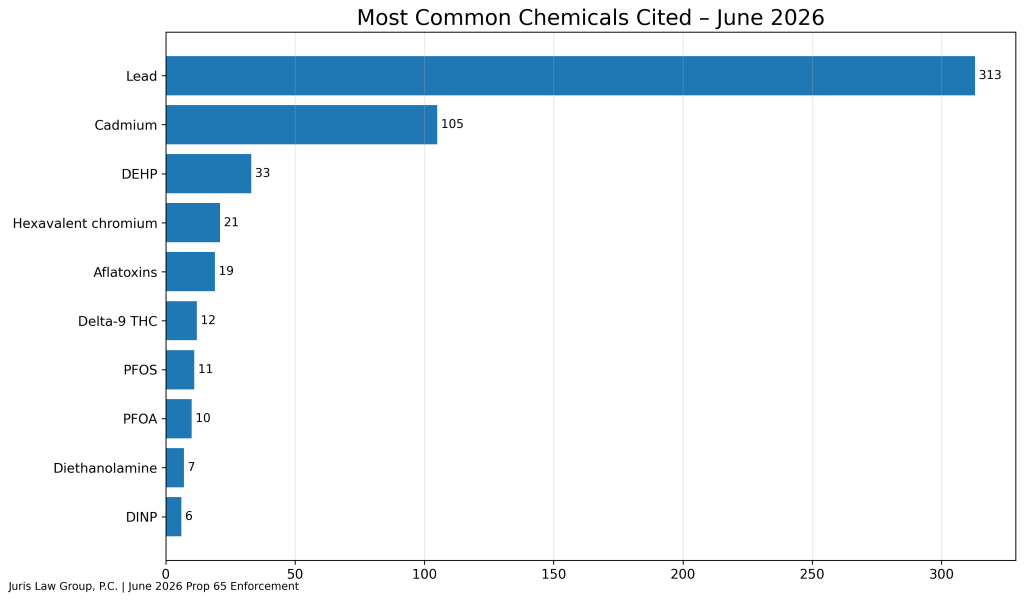
Lead continues to provide plaintiffs with the broadest enforcement platform because it appears across food, supplements, powders, spices, seafood, ceramic goods, and consumer products. Cadmium filings followed similar patterns, with concentration in agricultural and food-based categories where contamination may be tied to soil uptake, sourcing region, or raw-material variability.
DEHP remains a reliable phthalate target in flexible plastic and vinyl goods. Hexavalent chromium filings, by contrast, point to a different operational risk: leather processing and material treatment. These claims often create exposure for downstream sellers that did not manufacture or tan the material but sold the finished product into California.
Notable Chemical Trends
Lead in Food, Powders, and Imported Goods
Lead allegations dominated June filings. Notices targeted seafood, spices, powders, supplements, snack foods, mugs, and imported food products. For food and beverage companies, the practical risk is that lead may be present because of agricultural conditions, environmental uptake, or supply-chain variability rather than intentional formulation.
Cadmium in Agricultural and Seafood Products
Cadmium appeared frequently in food-related notices, often in combination with lead. This pattern is common in vegetables, seafood, sauces, and imported products. Cadmium claims create difficult defense issues because contamination levels can change by lot, supplier, region, and growing conditions.
Hexavalent Chromium in Leather Goods
June saw repeated hexavalent chromium notices involving leather wallets, suede boots, gloves, footwear, watches, and accessories. These claims are tied to leather tanning and material processing, not merely product labeling. Brand owners, retailers, and licensors should treat leather supply chains as a Prop 65 issue, particularly when products are imported or sold through national retail channels.
DEHP in Plastic and Vinyl Products
DEHP remained active in flexible plastic goods, vinyl materials, accessories, and household products. These claims continue to generate settlement pressure because plasticizers may be present in product components, packaging, or coatings. Retailers selling low-cost imported goods remain common targets.
Aflatoxins in Food Products
Aflatoxin notices remained visible in June, especially in agricultural food products such as nuts, seeds, spices, and related commodities. These allegations often arise from storage, moisture, agricultural handling, and raw-material controls rather than finished-product formulation.
PFAS Claims Continue Moving Across Categories
PFOA and PFOS appeared in a smaller number of notices, but these claims remain high-risk because many PFAS compounds lack clear safe harbor levels. Plaintiffs are likely to continue testing packaging, coatings, waterproof goods, and consumer products for PFAS-related exposure theories.
Cannabis and Delta-9 THC Notices Remain Active
Delta-9 THC notices continued in June, reinforcing the exposure faced by cannabis and hemp-derived product companies. Cannabis businesses must evaluate Prop 65 warnings for THC, marijuana smoke, heavy metals, solvents, and packaging-related chemicals.
Product Categories Most Frequently Targeted
Food & Beverage
- Seafood products, including shrimp-flavored chips and mussels in sauce
- Spices and botanical powders, including cinnamon and berberine products
- Protein powders and collagen powders
- Seaweed and vegetable-based products
- Snacks, sauces, and imported packaged foods
Leather Goods and Accessories
- Leather wallets
- Suede boots and clogs
- Leather gloves
- Watches with leather components
- Belts, bracelets, and footwear
Plastic and Vinyl Consumer Goods
- Vinyl and plastic accessories
- Children’s activity sets
- Household items
- Flexible plastic products
- Plastic packaging and consumer-product components
Personal Care and Wellness
- Lotions, creams, gels, and grooming products
- Products involving diethanolamine allegations
- Supplements and wellness powders
Cannabis and Hemp
- THC products
- Hemp-derived goods
- Cannabis-related consumer products
Product Category Table – JUNE 2026
| Product Category | Enforcement Activity |
|---|---|
| Food & Beverage | Very High |
| Agricultural Products / Produce | Very High |
| Leather Goods / Accessories | High |
| Plastic / Vinyl Consumer Goods | High |
| Household Goods | Moderate |
| Personal Care / Cosmetics | Moderate |
| Cannabis / Hemp Products | Moderate |
| Thermal Labels / Receipts | Low but recurring |
Top Companies Cited – JUNE 2026
| Rank | Company / Retail Group | Notices |
|---|---|---|
| 1 | Amazon | 82 |
| 2 | The TJX Companies / HomeGoods / Marshalls | 26 |
| 3 | Walmart | 21 |
| 4 | Whole Foods Market | 18 |
| 5 | Aldi | 16 |
| 6 | Target | 13 |
| 7 | Sprouts Farmers Market | 12 |
| 8 | Macy’s | 11 |
| 9 | Kroger / Ralphs | 11 |
| 10 | Trader Joe’s | 7 |
| 11 | Albertsons / Vons / Safeway | 7 |
| 12 | Mars / Kevin’s Natural Foods | 6 |
| 13 | Ross Stores | 3 |
| 14 | Dollar Tree / Family Dollar | 3 |
| 15 | Fresh Express | 3 |
| 16 | NativePath | 3 |
| 17 | JCPenney | 2 |
| 18 | CVS | 2 |
| 19 | Cost Plus World Market | 2 |
| 20 | Costco | 1 |
Retailer targeting remained pronounced in June. The companies most frequently named operate national or regional distribution systems, ecommerce channels, private-label programs, or high-volume California sales operations. Plaintiffs often name retailers because they are easier to identify, easier to serve, and more likely to have established settlement procedures.
Amazon’s continued prominence reinforces the importance of online warning workflows. Marketplace sellers should not assume that product-label warnings alone are enough. California Prop 65 warning obligations apply before purchase, which means ecommerce display, product-page configuration, and third-party listing control can become enforcement issues.
Top Noticing Parties – JUNE 2026
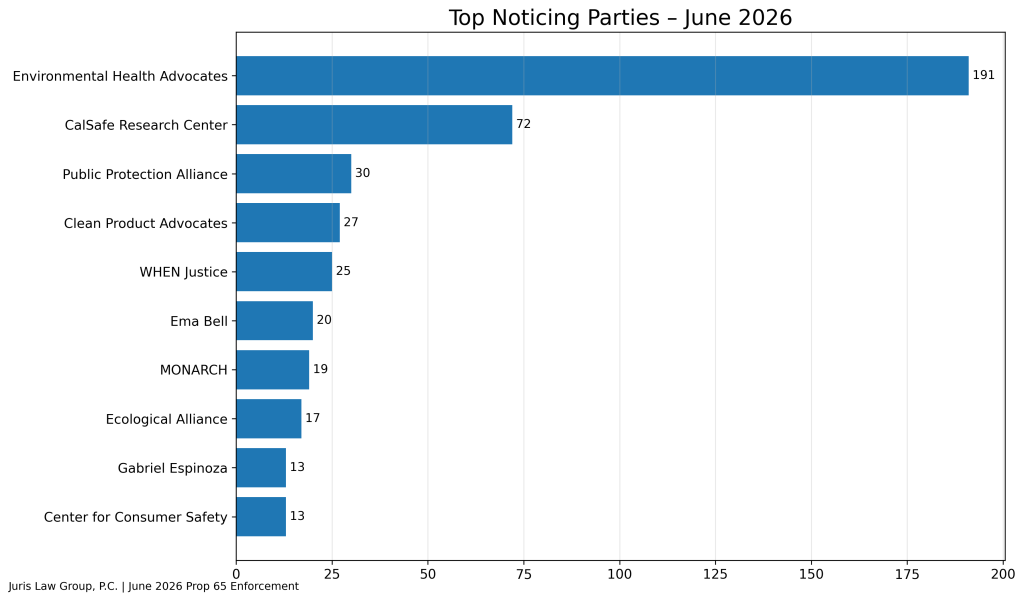
The June dataset reflects high concentration among a limited group of noticing parties. Environmental Health Advocates alone accounted for a substantial share of total notices, followed by CalSafe Research Center and Public Protection Alliance.
This concentration matters because active noticing parties tend to develop category-specific strategies. Once a group begins filing against a product type, related products, adjacent materials, and competing sellers often follow. Companies should monitor plaintiff activity not only by chemical but also by noticing party and product category.
Emerging Enforcement Areas
PFAS-related notices remain a forward-looking risk area despite lower June counts than lead or cadmium. The combination of regulatory attention, consumer scrutiny, and limited safe harbor guidance makes PFAS claims attractive for plaintiffs.
Hexavalent chromium in leather goods may also continue. June filings suggest that wallets, boots, gloves, and leather accessories are being tested with greater frequency. Retailers importing leather goods should evaluate whether suppliers are documenting tanning processes, chemical restrictions, and finished-product testing.
Ecommerce warning claims are likely to remain active. Plaintiffs can review online listings efficiently, compare product pages across platforms, and identify missing California warnings without physical retail visits. Amazon sellers, marketplace vendors, and private-label operators remain exposed where warning responsibility is not clearly assigned.
Legal Gap Analysis
A recurring gap is the distinction between product-content exposure and material-process exposure. Leather goods involving hexavalent chromium do not raise the same compliance questions as food products involving lead or cadmium. They require supplier controls over tanning, finishing, and chemical treatment.
Another gap involves online warning placement. Companies may place warnings on product packaging yet fail to display compliant warnings before online checkout. That creates a separate ecommerce liability issue.
A third gap involves multi-party distribution chains. Importers, distributors, brand owners, licensors, and retailers often assume another party has handled Prop 65 compliance. June filings show that plaintiffs do not limit notice recipients to the entity most responsible for the chemical issue.
Licensor and Private-Label Liability Considerations
Licensors, private-label sellers, and retailers remain exposed when their names appear on product packaging, online listings, or branded product pages. A company does not need to manufacture the product to be named in a Prop 65 notice.
Protective measures should include:
- Prop 65 compliance warranties in license and supply agreements
- Mandatory chemical testing obligations
- Indemnity provisions covering notices, settlements, penalties, and fees
- Insurance obligations for licensees and suppliers
- Review rights for packaging, labeling, and online listings
- Supplier disclosure obligations for materials, coatings, and chemical treatments
Private-label retailers should pay close attention to food, supplements, leather goods, plastic accessories, and imported consumer products. These categories generated substantial June activity and often involve upstream suppliers outside California.
Practical Risk Management Considerations
1. Testing Protocols
Testing should cover finished goods, raw materials, and packaging components. For food products, testing should account for lot variability and supplier-specific risk.
2. Packaging Review
Packaging, labels, coatings, adhesives, and plastics should be reviewed separately from product contents. Packaging-driven claims can create exposure even when the underlying product formulation is not the source of the chemical.
3. Warning Language
Warnings should be reviewed for physical packaging and ecommerce display. Online warnings must appear before purchase for California consumers.
4. Supplier Agreements
Supplier contracts should assign responsibility for testing, warnings, indemnity, insurance, and corrective action. General compliance language is often insufficient.
5. Monitoring Enforcement Activity
Companies should monitor 60-day notices by chemical, plaintiff, product category, and retailer target. Competitor notices often provide early warning of future claims.
6. Counsel Involvement
Early legal review can help determine whether to test, label, reformulate, negotiate, or challenge a notice. Waiting until litigation is filed narrows available options.
STRATEGIC BY DESIGN: Juris Law Group on Prop 65 Enforcement
Our Prop 65 attorneys frequently see enforcement activity move through product categories in waves. Plaintiffs test a category, identify recurring chemical issues, then expand outward to related products, retailers, private-label brands, and ecommerce sellers.
As CPG attorneys in California, we regularly assess Prop 65 enforcement through the lens of plaintiff behavior. June 2026 filings show continued pressure on food and beverage products, imported goods, leather accessories, flexible plastics, online marketplaces, and retailer distribution channels. Companies selling into California should treat Prop 65 not as a labeling issue alone, but as a supply-chain, ecommerce, and litigation-risk issue.
Common Enforcement Inquiries
Can Amazon sellers receive Prop 65 notices?
Yes. Amazon sellers can receive notices directly, and Amazon may also be named where the product is sold through its marketplace. Sellers should confirm whether warnings appear before purchase and whether the listing accurately identifies the responsible seller or brand.
Are imported foods more exposed to Prop 65 claims?
Yes. Imported foods often involve raw-material variability, different agricultural conditions, and limited supplier documentation. Lead, cadmium, aflatoxins, and other contaminants can vary by region, supplier, and production lot.
Do leather products create Prop 65 risk?
Yes. June notices involving wallets, boots, gloves, and leather accessories show continued enforcement around hexavalent chromium. These claims often arise from tanning and finishing processes.
Can a retailer be liable for a product it did not manufacture?
Yes. Retailers, distributors, and private-label sellers may be named if they sell the product into California or control the brand, packaging, or online listing.
Are PFAS claims expected to continue?
Yes. PFAS claims remain attractive to plaintiffs because several compounds lack clear safe harbor levels and may appear in coatings, packaging, waterproof materials, and consumer goods.
Strategic Outlook
June 2026 enforcement data suggests that plaintiffs will continue focusing on product categories where chemical exposure is difficult to eliminate and settlement leverage remains strong. Lead and cadmium will likely remain dominant in food, supplements, powders, seafood, and imported products. DEHP and related phthalates will continue appearing in flexible plastics, vinyl goods, accessories, and household products.
Retailers, marketplace sellers, licensors, and private-label brands should expect sustained pressure. The next wave of filings is likely to focus on supply-chain documentation, leather-processing chemicals, ecommerce warning failures, PFAS in consumer goods, and recurring heavy-metal allegations in food and agricultural products.
About Juris Law Group
Juris Law Group serves as trusted Proposition 65 counsel to manufacturers, retailers, importers, distributors, food and beverage companies, supplement brands, cosmetic companies, cannabis businesses, and consumer products companies operating in California.
Our services include Proposition 65 compliance programs, product and packaging audits, warning label strategy, supply-chain reviews, retailer and private-label compliance counseling, and defense of 60-day notices and enforcement actions.
Want to Protect Your Brand from a Prop 65 Lawsuit?
To speak with a regulatory attorney or schedule a compliance audit, contact us today: