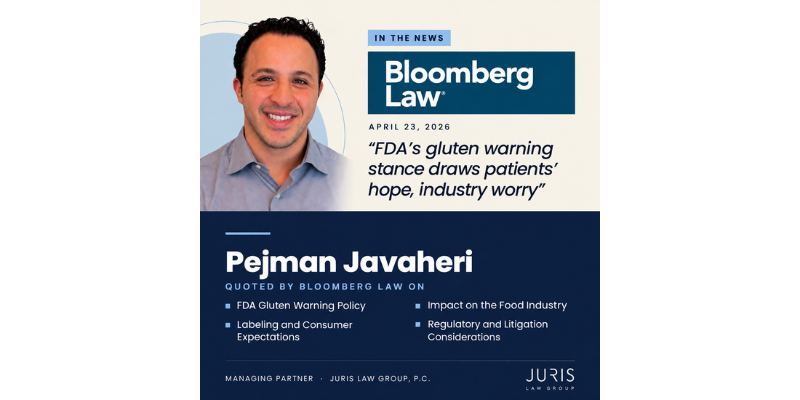
Pejman Javaheri, Esq., managing partner and founder of Juris Law Group, P.C., was recently quoted in a Bloomberg Law article examining the Food and Drug Administration’s evolving position on gluten-related labeling and disclosures. The article brings together perspectives from regulators, patient advocates, and legal practitioners on a developing area of food and beverage regulation.
The coverage focuses on whether the FDA may shift toward stricter warning requirements for gluten exposure, particularly in cases involving cross-contact rather than intentional ingredients. Advocacy groups have called for broader disclosures to better protect individuals with celiac disease, while industry stakeholders have raised concerns about feasibility and the potential for overbroad labeling obligations. The discussion reflects a familiar tension in consumer protection law: how to balance clearer warnings with practical manufacturing realities.
Javaheri’s contribution addresses the legal implications of a potential policy change. He notes that “this would be an abrupt change in how FDA has dealt with allergens before,” signaling a departure from established regulatory approaches. His comments also emphasize the enforcement and litigation dimension of allergen disclosures, observing that “the non-disclosure of an allergen is the No. 1 reason why products get recalled.” In that context, he points to recent history, explaining that after Congress designated sesame as the ninth major allergen in 2021, class action filings increased against companies that failed to disclose its presence.
These observations underscore a broader pattern in food and beverage regulation. Changes in allergen classification or disclosure expectations often lead to immediate downstream effects, including recalls, regulatory scrutiny, and private litigation. For companies, the issue extends beyond technical compliance. Labeling decisions are frequently tested against consumer expectations and plaintiff theories, particularly in jurisdictions where false advertising and consumer protection claims are actively litigated.
The potential expansion of gluten-related warnings raises similar considerations. Manufacturers must evaluate cross-contact risks, supplier controls, and labeling language, while anticipating how those disclosures may be interpreted by regulators and courts. Even incremental shifts in FDA posture can alter the litigation landscape, particularly where plaintiffs argue that disclosures were incomplete or insufficiently prominent.
Javaheri’s inclusion in the Bloomberg Law article reflects his work advising clients on labeling compliance, enforcement exposure, and risk management in the food and beverage sector. Juris Law Group, P.C. brings decades of experience in these matters, representing companies across the industry in regulatory and litigation contexts. Pejman Javaheri has been recognized by the Daily Journal and the World Trademark Review (WTR) for his work in intellectual property and brand protection, areas that increasingly intersect with labeling and consumer protection issues.