California Proposition 65 enforcement activity accelerated sharply during May 2026, with 620 Notices of Violation (NOVs) issued across food, supplement, consumer product, household goods, cannabis, personal care, and retail sectors. The month was characterized by a heavy concentration of notices involving lead, cadmium, aflatoxins, phthalates, PFAS compounds, and packaging-related exposure allegations.
The data reveals continued plaintiff focus on products where contamination risk is difficult to eliminate entirely, particularly imported foods, produce, seafood, supplements, thermal paper applications, cannabis products, and flexible plastic materials. Large retailers, ecommerce sellers, private-label distributors, and importers remain frequent targets because they occupy the final point of distribution and often possess the greatest settlement leverage.
Perhaps most notable is the continued concentration of notices among a relatively small group of repeat plaintiffs and advocacy organizations. This pattern reinforces a recurring reality of California Prop 65 enforcement: plaintiffs increasingly focus on categories where testing methodologies are well established, exposure calculations are difficult to challenge economically, and reformulation costs frequently exceed litigation defense costs.
Monthly Violation Summary
| Number of Violations | Listed Chemicals | Types of Products Targeted |
|---|---|---|
| 368 | Lead | Produce, seafood, sauces, imported foods, supplements, consumer products |
| 119 | Cadmium | Vegetables, spices, food products, imported goods |
| 46 | DEHP | Plastic goods, vinyl materials, household products, accessories |
| 43 | Aflatoxins | Nuts, seeds, food products, agricultural commodities |
| 33 | PFOA, PFOS and PFAS-related compounds | Cannabis products, consumer goods, packaging applications |
| 14 | Diethanolamine | Personal care products, grooming products |
| 13 | Delta-9 THC | Cannabis products, hemp-derived products |
Prop 65 Enforcement Observations — May 2026
May filings demonstrate that plaintiffs remain focused on categories where chemical exposure arises from supply-chain variability rather than isolated manufacturing defects. Imported food products, produce, seafood, spices, supplements, and packaged consumer goods collectively accounted for a substantial share of notices.
Retailers continue to face elevated exposure. Numerous notices named large retailers alongside manufacturers and distributors, reflecting the practical reality that retailers often serve as attractive settlement targets because they possess broader resources and stronger incentives to resolve claims quickly.
Packaging-related allegations also remain prominent. Plaintiffs continue pursuing exposure theories tied not only to product contents but also to packaging components, thermal labels, inks, coatings, and plastic materials. This trend is particularly relevant for ecommerce sellers, whose products often move through complex supply chains involving multiple packaging vendors.
The continued presence of PFAS, BPS, and cannabis-related notices suggests that plaintiffs remain focused on chemicals lacking clear safe harbor levels. These categories frequently present greater uncertainty and therefore greater litigation risk.
Most Common Chemicals Cited
| Rank | Chemical | Notices |
|---|---|---|
| 1 | Lead | 368 |
| 2 | Cadmium | 119 |
| 3 | DEHP | 46 |
| 4 | Aflatoxins | 43 |
| 5 | PFOA | 20 |
| 6 | Diethanolamine | 14 |
| 7 | Delta-9 THC | 13 |
| 8 | Ochratoxin A | 8 |
| 9 | BPS | 7 |
| 10 | PFOS | 6 |
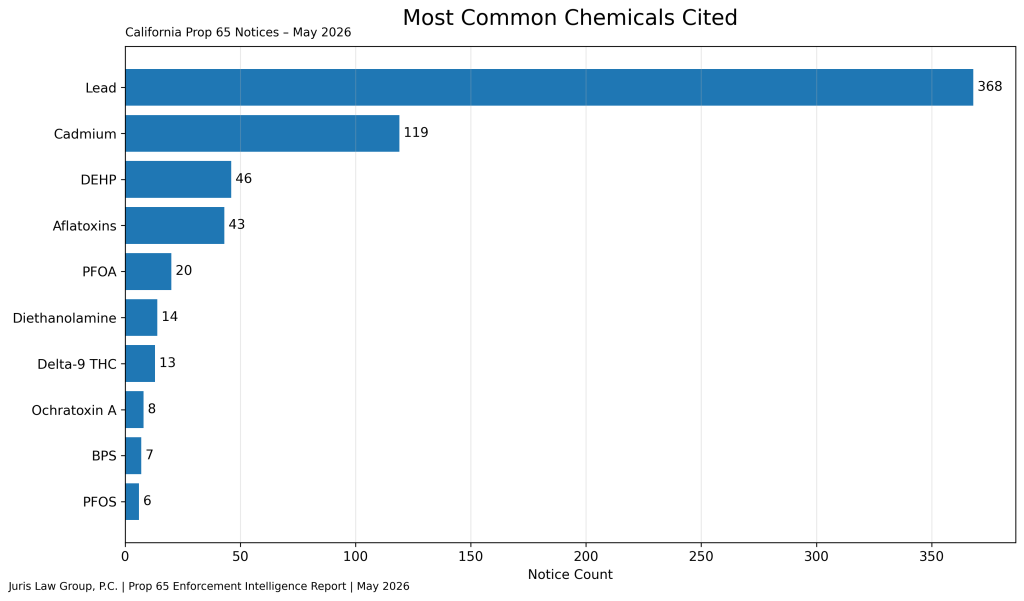
Most Common Chemicals Cited
Enforcement Analysis
Lead continues to dominate California Prop 65 enforcement because it appears across an exceptionally broad range of products and often occurs naturally in agricultural commodities. This makes complete elimination difficult and creates recurring testing disputes.
Cadmium filings similarly remain concentrated in food and agricultural products, where contamination may arise from soil conditions, environmental uptake, or sourcing variability. These cases frequently involve products imported through multi-tier distribution channels.
DEHP remains the primary phthalate target, reflecting continuing scrutiny of flexible plastics, vinyl materials, coatings, and consumer-product components. The persistence of DEHP notices demonstrates that plaintiffs continue to view plastic-related exposures as a reliable source of enforcement activity.
Aflatoxin-related filings represent a separate but increasingly important category. Unlike many traditional Prop 65 chemicals, aflatoxin exposure often stems from agricultural storage and handling conditions rather than manufacturing decisions.
Notable Chemical Trends
Lead Concentration in Food Products
Lead-based notices dominated May filings, particularly among produce, seafood, sauces, seasonings, and imported food products. Plaintiffs continue targeting categories where naturally occurring contamination creates recurring testing variability and where supply-chain controls may differ substantially among suppliers.
Cadmium in Agricultural Commodities
Cadmium notices frequently accompanied lead allegations in vegetables, spices, and agricultural products. Because cadmium uptake can vary significantly based on soil conditions and growing regions, importers often face substantial compliance challenges.
DEHP in Flexible Plastic Applications
DEHP continues to appear in notices involving plastic materials, household goods, accessories, and consumer-product packaging. Plaintiffs remain focused on flexible materials where migration and exposure allegations are relatively straightforward to assert.
PFAS Expansion Beyond Traditional Packaging
PFAS-related filings continue expanding beyond food-contact packaging into broader consumer-product applications. The absence of clear safe harbor levels increases litigation uncertainty and creates additional pressure on manufacturers to conduct targeted testing.
Aflatoxins in Food and Agricultural Products
Aflatoxin notices remained active throughout May. These cases reinforce plaintiff interest in contaminants that arise from agricultural production, storage, and distribution practices rather than finished-product formulation.
Cannabis and THC Enforcement
Delta-9 THC notices remain concentrated in cannabis and hemp-derived products. This sector continues to experience heightened scrutiny because multiple Prop 65-listed chemicals can arise within the same product category.
Product Categories Most Frequently Targeted
Food & Beverage
- Fresh vegetables and leafy greens
- Seafood products
- Sauces and condiments
- Imported food products
- Spices and seasonings
Supplements & Wellness Products
- Nutritional supplements
- Botanical products
- Functional wellness products
Cannabis & Hemp Products
- THC products
- Hemp-derived products
- Cannabis-infused consumer goods
Household & Consumer Products
- Plastic consumer products
- Household accessories
- Retail merchandise
Packaging & Materials
- Flexible plastics
- Packaging materials
- Coated surfaces
- Thermal labeling applications
Ranked Product Category Table
| Product Category | Relative Enforcement Activity |
|---|---|
| Food & Beverage | Very High |
| Produce & Agricultural Products | Very High |
| Household Consumer Goods | High |
| Packaging & Plastics | High |
| Supplements | Moderate |
| Cannabis & Hemp Products | Moderate |
| Personal Care Products | Moderate |
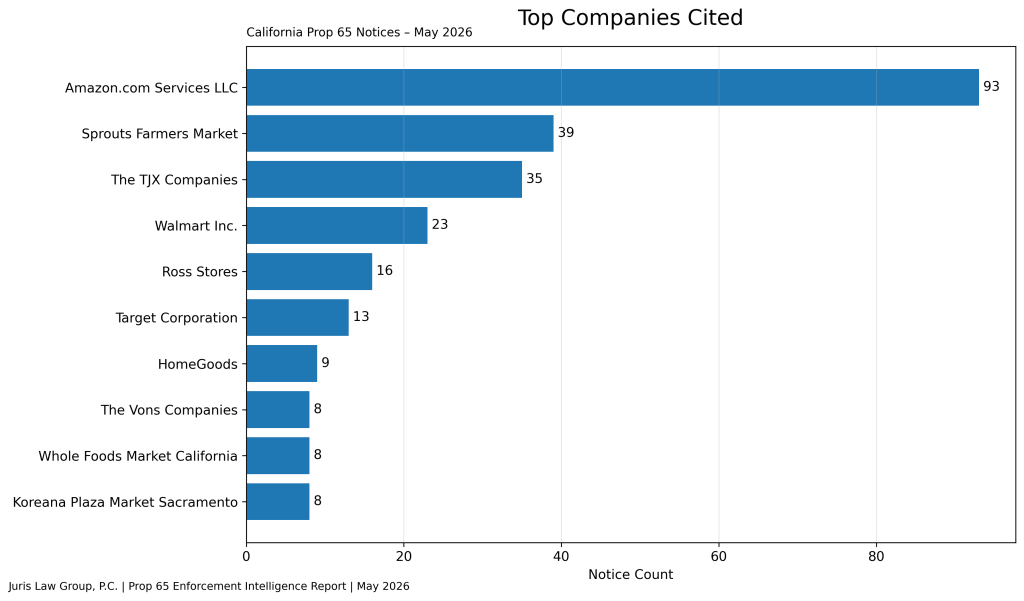
Top Companies Cited
Enforcement Analysis
Retailers remain central enforcement targets because they often represent the final link in the California distribution chain. Large retailers frequently appear alongside manufacturers and importers, even when they had little involvement in product design or sourcing decisions.
Amazon’s continued prominence reflects broader ecommerce liability concerns. Plaintiffs increasingly view online marketplaces as efficient enforcement targets because product listings, warnings, and California-specific disclosures can be evaluated at scale.
Private-label programs also remain vulnerable. Retailers frequently assume exposure generated by third-party manufacturers when products are sold under retailer-controlled branding.
Top Noticing Parties
| Noticing Party | Notices |
|---|---|
| Environmental Health Advocates, Inc. | 245 |
| Public Protection Alliance LLC | 57 |
| Calsafe Research Center, Inc. | 56 |
| Gabriel Espinoza | 32 |
| Ecological Alliance, LLC | 27 |
| CalSafe Research Center, Inc. | 26 |
| Precila Balabbo | 18 |
| Clean Product Advocates, LLC | 17 |
| Dennis Johnson | 17 |
| Public Health Enforcement Advocates, LLC | 15 |
Plaintiff Intelligence Analysis
The May data reflects substantial concentration among a relatively small number of active noticing parties. This concentration suggests increasingly sophisticated targeting strategies focused on product categories where testing protocols are established and settlement economics favor early resolution.
Several organizations continue demonstrating specialization in food products, agricultural commodities, consumer goods, and packaging-related exposures. Businesses should monitor these patterns because plaintiff specialization often precedes expansion into adjacent product categories.
Emerging Enforcement Areas
Several developing trends warrant close attention:
- PFAS enforcement continues expanding into broader consumer-product categories.
- Packaging migration theories remain active and may increase.
- Ecommerce warning-display allegations continue creating exposure for online sellers.
- Cannabis and hemp products remain under elevated scrutiny.
- Thermal labels and receipt-related BPS claims continue appearing despite BPA reformulation efforts.
- Agricultural contaminants such as aflatoxins and heavy metals remain recurring targets.
- Imported foods continue generating disproportionate enforcement activity.
Legal Gap Analysis
One recurring blind spot involves packaging-related exposure claims. Many companies focus heavily on product-content testing while devoting comparatively little attention to packaging components, inks, adhesives, labels, and coatings.
A second area involves ecommerce warning compliance. Products may contain compliant warnings on physical packaging while failing to display adequate California warnings during online purchase transactions.
A third exposure area involves retailer and private-label liability. Businesses frequently assume manufacturers bear primary responsibility, yet retailers and brand owners continue appearing as defendants in substantial numbers.
Licensor and Private-Label Liability Considerations
Trademark licensors and private-label sellers face continuing exposure under California Prop 65 even when they do not manufacture products directly.
Recommended protections include:
- Prop 65 compliance provisions in licensing agreements
- Mandatory testing obligations
- Broad indemnity provisions
- Insurance requirements
- Ongoing marketplace monitoring
- Packaging review procedures
Companies that rely heavily on third-party manufacturing should periodically reassess how compliance responsibilities are allocated throughout the supply chain.
Practical Risk Management Considerations
1. Testing Protocols
Testing programs should address finished products, raw materials, and packaging components. Agricultural products require particular attention because contamination levels may vary significantly among suppliers.
2. Packaging Review
Packaging materials increasingly serve as independent sources of liability. Labels, coatings, adhesives, and plastic components should be incorporated into compliance reviews.
3. Warning Language
Warning compliance must extend beyond product packaging to ecommerce listings and online purchasing platforms.
4. Supplier Agreements
Supplier contracts should allocate testing obligations, indemnity responsibilities, and corrective-action requirements with precision.
5. Monitoring Enforcement Activity
Regular review of 60-day notices can help identify plaintiff focus areas before a business becomes a target.
6. Counsel Involvement
Early legal review often provides greater flexibility than attempting to respond after a notice is received.
The Juris Law Group Perspective on Prop 65 Enforcement
Our Prop 65 attorneys frequently observe that enforcement activity follows identifiable patterns. Plaintiff groups rarely target categories randomly. Instead, they concentrate on products where testing methodologies are established, exposure calculations create leverage, and corrective measures can be expensive.
We regularly assess enforcement activity not merely to identify current risks but also to anticipate future filing trends. Recent notice activity suggests continued pressure on food products, packaging applications, ecommerce sellers, private-label programs, and PFAS-related exposures.
Common Enforcement Inquiries
Can Amazon sellers receive Prop 65 notices directly?
Yes. Ecommerce sellers remain subject to the same warning obligations as traditional retailers. Plaintiffs increasingly review online listings and warning disclosures as part of their enforcement efforts.
Are imported products more likely to trigger Prop 65 claims?
Imported products frequently appear in notices because supply-chain visibility can be limited and testing practices often vary among suppliers.
Can naturally occurring contaminants still create liability?
Yes. Prop 65 does not exempt naturally occurring contaminants simply because they originate from environmental conditions or agricultural processes.
Do private-label retailers face independent liability?
Yes. Retailers selling products under their own brands frequently appear in notices alongside manufacturers and distributors.
Are PFAS notices expected to increase?
Current enforcement trends suggest continued growth in PFAS-related filings due to regulatory attention, consumer scrutiny, and the absence of established safe harbor levels for many compounds.
Strategic Outlook
The May 2026 notice data suggests plaintiffs will continue concentrating on categories where contamination cannot easily be eliminated and where exposure calculations remain difficult to challenge. Food products, supplements, cannabis goods, packaging materials, and consumer products with complex international supply chains are likely to remain primary targets.
Retailers, ecommerce operators, licensors, and private-label sellers should expect continued scrutiny. As enforcement theories expand beyond product contents into packaging migration, online warning practices, and supply-chain controls, companies that rely solely on finished-product testing may find themselves exposed to claims originating elsewhere in the distribution chain.
About Juris Law Group
Juris Law Group serves as trusted Proposition 65 counsel to manufacturers, retailers, importers, distributors, food and beverage companies, supplement brands, cosmetic companies, and consumer products businesses operating in California.
Our services include:
- Proposition 65 compliance programs
- Product and packaging audits
- Warning label strategy
- Supply-chain reviews
- Retailer and private-label compliance counseling
- Defense of 60-day notices and enforcement actions
Want to Protect Your Brand from a Prop 65 Lawsuit?
To speak with a regulatory attorney or schedule a compliance audit, contact us today: