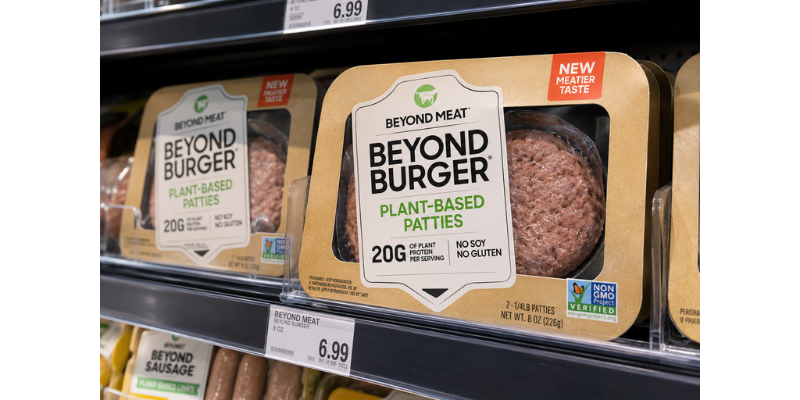
A few words of advertising copy have left Beyond Meat facing a $15.4 million judgment.
On September 18, 2026, the U.S. District Court for the District of Massachusetts entered judgment against Beyond Meat in a trademark dispute brought by Sonate Corporation, which does business as Vegadelphia Foods. The dispute centered on Beyond Meat’s use of “PLANT BASED GREAT TASTE” and its involvement in Dunkin’s use of “GREAT TASTE PLANT-BASED,” phrases Vegadelphia argued infringed its registered WHERE GREAT TASTE IS PLANT-BASED® trademark. The court entered judgment for approximately $15.44 million, consisting of $37,500 in actual damages and $15.4 million in disgorged profits.
The result presents a broader issue for food and consumer brands. Marketing teams routinely develop short phrases that describe taste, ingredients, performance or other product attributes. But language intended as advertising copy can still encounter another company’s trademark rights, and describing a product does not automatically insulate the advertiser from infringement.
Beyond Meat’s Trademark Dispute Began With a Descriptive-Sounding Slogan
Vegadelphia’s lawsuit dates to April 2022. The company alleged that Beyond Meat and Dunkin’s use of “GREAT TASTE PLANT-BASED” infringed its WHERE GREAT TASTE IS PLANT-BASED® mark. Vegadelphia also challenged Beyond Meat’s separate use of “PLANT-BASED GREAT TASTE” in connection with its products.
Beyond Meat disputed that the phrases were likely to cause consumer confusion and raised trademark fair use as a defense. In simplified terms, trademark law can permit a company to use ordinary descriptive language in its normal descriptive sense rather than as a brand identifier. Beyond Meat maintained that its use of the disputed phrases fell within that principle.
The history of Beyond Meat’s own trademark application, however, adds an important dimension. In January 2020, Beyond Meat’s outside counsel discovered Vegadelphia’s existing trademark registration. Beyond Meat subsequently filed an application in March 2020 seeking registration of PLANT-BASED GREAT TASTE. The USPTO later refused registration, including on likelihood-of-confusion and descriptiveness grounds.
That sequence illustrates a recurring problem in advertising clearance. A phrase can contain words that individually describe the product and still present trademark exposure when the phrase as a whole comes too close to an existing mark. The question is therefore broader than whether the marketing department considers the words descriptive.
Descriptive Advertising Can Still Create Trademark Infringement Exposure
The legal distinction between descriptive use and trademark use is particularly relevant to consumer products because CPG advertising depends heavily on short, repeatable statements. Words describing taste, ingredients, sustainability, performance or health attributes may appear on packaging, retail displays, digital advertising and partnership campaigns.
Repeated use can complicate the analysis. Typography, placement, frequency, surrounding branding and the context in which consumers encounter the phrase can affect whether language is perceived simply as information about a product or as something identifying its commercial source.
Beyond Meat’s case illustrates the limits of assuming that a phrase is safe because its component words describe the product. After a two-week trial, the jury found in Vegadelphia’s favor on its federal trademark claims. The September 18 judgment entered liability under Sections 1114 and 1125 of the Lanham Act, as well as on the surviving federal contributory infringement claim.
This is also where the case should be distinguished from a conventional false advertising lawsuit. The dispute implicated Section 1125 of the Lanham Act, but the central issue was confusion over source, sponsorship or affiliation—not whether Beyond Meat made a scientifically or factually false representation about the characteristics of its food. For brands reviewing advertising copy, those are separate forms of exposure even though both can arise from the same campaign.
The $15.4 Million Beyond Meat Judgment Shows Why Trademark Damages Matter
The September ruling is particularly instructive because the court substantially reduced one portion of Vegadelphia’s recovery while leaving another largely intact.
The jury had initially awarded approximately $38.9 million, including $23.5 million in actual damages and $15.4 million tied to Beyond Meat’s profits. The court subsequently determined that Vegadelphia was entitled to only $37,500 in actual damages. The court nevertheless accepted the $15.4 million disgorgement amount as an equitable measure of harm resulting from Beyond Meat’s infringement. Final judgment was therefore entered for $15,437,500.
The distinction matters. A trademark owner seeking actual damages generally needs evidence connecting the infringement to its claimed economic loss. A claim that an infringement destroyed a valuable business opportunity, for example, requires evidence supporting that connection. The court found Vegadelphia’s proof insufficient to sustain most of the original actual-damages award.
Disgorgement addresses a different question: whether profits earned by the infringer should be awarded as an equitable remedy. Here, the court retained the $15.4 million award as a rough measure of harm that was not otherwise captured by actual damages, while emphasizing that recovery under the Lanham Act must compensate rather than punish.
For brand owners, that distinction changes the economics of trademark risk. Limited proof of the trademark owner’s direct losses does not necessarily mean limited financial exposure for the accused company.
strategic by design: The Juris Law Group, p.c. Perspective
Advertising clearance should extend beyond logos, product names and primary brand identifiers. Our IP attorneys assess slogans, packaging language, campaign phrases and co-branded creative with the same underlying question: could consumers understand the wording as identifying or connecting a commercial source, and are there earlier rights that make its proposed use problematic?
That review becomes more important when a campaign will receive national exposure or involve multiple commercial partners. Trademark protection lawyers can address clearance before a phrase is incorporated across packaging, point-of-sale materials, digital media and retailer campaigns, when changing course is generally less disruptive. The principle also reflects the portfolio discipline behind Bigger is not better, better is better®: a short phrase can itself carry substantial brand value, but that value depends on how it is selected, protected and used.
The Beyond Meat dispute adds a partnership dimension. Dunkin’ participated in the challenged campaign but settled its involvement following mediation in September 2024 and was dismissed from the case with prejudice that November. The litigation continued against Beyond Meat.
Co-branded campaigns therefore warrant attention not only to trademark clearance but also to contractual allocation of responsibility. Approval rights, representations regarding IP ownership, indemnification provisions and responsibility for campaign materials can determine what happens when seemingly routine advertising copy produces a third-party claim.
Advertising Slogan Clearance After the Beyond Meat Decision
Over the next 12 months, the Beyond Meat litigation is likely to remain relevant to companies evaluating how aggressively descriptive phrases can be used in consumer advertising. The September judgment does not mean that ordinary descriptive language automatically becomes trademark infringement. It does show why the analysis cannot stop at the words themselves. Existing registrations, similarity between the phrases, the products involved and the manner in which consumers encounter the language all remain part of the assessment.
For food, beverage and other consumer brands, the practical issue begins much earlier than litigation. Advertising slogans often move rapidly from creative development into packaging, retail, social media and licensing or partnership campaigns. A phrase that has already been deployed nationally can be expensive to replace even before damages enter the equation. Integrating trademark clearance into campaign development gives companies an opportunity to identify conflicts while the language can still be changed, rather than after consumer exposure and marketing investment have multiplied the consequences.
Common Legal Inquiries
Can a descriptive advertising slogan infringe a trademark?
Yes. Descriptive wording is not automatically free from trademark claims. The analysis can depend on whether the words are being used descriptively or as a source identifier, the similarity to an existing trademark, the relatedness of the goods or services and whether the overall circumstances create a likelihood of consumer confusion.
Should advertising slogans be searched before a campaign launches?
For slogans that will receive substantial or repeated commercial use, trademark clearance can identify earlier registrations and uses that may present problems. This can be especially important when the phrase will appear across packaging, retail displays, digital advertising or national campaigns, where changing the language after launch may become costly.
Is trademark infringement the same as false advertising under the Lanham Act?
No. Trademark infringement generally focuses on consumer confusion concerning the source, sponsorship or affiliation of goods or services. Traditional false advertising claims generally concern false or misleading statements about a product or its qualities. The Beyond Meat litigation principally concerned trademark and source-confusion theories rather than a finding that its plant-based products were falsely described.