Crocs’ latest infringement lawsuit reaches beyond the familiar question of how closely another clog can resemble its Classic Clog. The case puts several forms of intellectual property protection around the same commercial product ecosystem into a single dispute.
On September 18, 2026, Crocs, Inc. and its subsidiary Jibbitz, Inc. sued Five Below, Inc. in the U.S. District Court for the District of Colorado. The complaint targets Five Below’s “Juniors Charm Clog,” decorative shoe charms and a clog-shaped accessory, asserting two registered three-dimensional trademarks, one design patent and three utility patents. Crocs and Jibbitz allege trademark and trade dress infringement and dilution, patent infringement and unfair competition, among other claims. The allegations have not yet been adjudicated.
For consumer-product companies, the case presents a useful examination of how a recognizable product can accumulate different IP rights as the underlying brand expands. Product configuration, ornamental design, functional systems and accessories can raise separate protection and enforcement questions even when consumers experience them as parts of a single brand.
Crocs’ Classic Clog Trade Dress Extends Protection Beyond the Brand Name
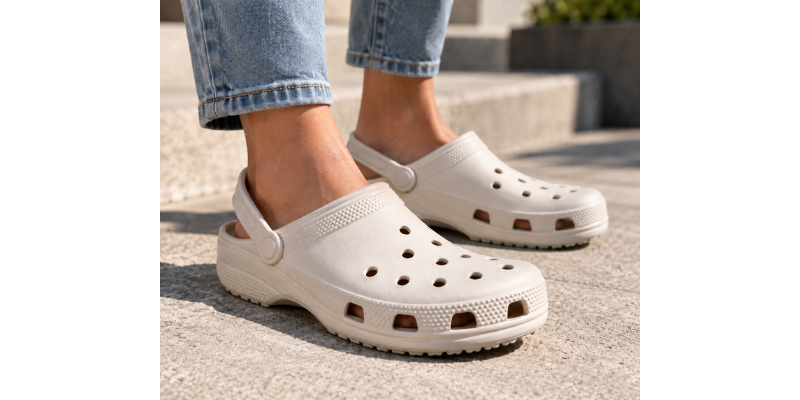
Crocs’ trademark allegations rely in part on U.S. Trademark Registration Nos. 5,149,328 and 5,273,875. The registrations cover elements of the three-dimensional configuration associated with its Classic Clog, rather than simply the CROCS word mark.
Crocs alleges that Five Below’s Juniors Charm Clog incorporates protected features of that configuration in a manner likely to cause confusion regarding source, sponsorship or affiliation. That distinction is central to product configuration trade dress. When the appearance of a product has acquired source-identifying significance and satisfies the other requirements for protection, trademark law can potentially reach conduct even where a competing product does not reproduce the brand owner’s name or conventional logo.
Crocs also targets Five Below’s “Novelty Shoe Purse,” a clog-shaped accessory with a perforated front and silhouette that Crocs alleges incorporates its Classic Clog trade dress. Crocs itself has extended its clog design into accessories, including its Classic Clog Pouch Bag Charm. The allegation therefore raises an issue that becomes increasingly relevant as consumer brands expand: recognizable product design can migrate from the original product category into merchandise that uses the design itself as a brand reference.
The scope of those rights should not be overstated. Crocs previously asserted the same two 3D trademark registrations in a U.S. International Trade Commission proceeding involving competing footwear. The ITC ultimately found no violation by the participating respondents because Crocs failed to establish likelihood of confusion, infringement or dilution as to those respondents. In January 2026, the Federal Circuit dismissed Crocs’ appeal of that portion of the decision as untimely while affirming limited relief against defaulting respondents.
The Five Below litigation therefore begins with registered rights, but the existence of those registrations does not resolve whether Five Below’s particular products infringe them.
Design and Utility Patents Add Separate Protection Around the Product
The patent claims illustrate another part of Crocs’ portfolio strategy. Crocs is asserting U.S. Design Patent No. D1,100,450, which covers an ornamental footwear design associated with its Saru Clog. It alleges that the design of Five Below’s Juniors Charm Clog infringes that patent.
A design patent and product configuration trade dress can address different legal interests even when both relate to product appearance. Design patents protect qualifying ornamental designs for a defined patent term, while trade dress protection turns on trademark principles, including whether the asserted configuration serves a source-identifying function and whether the accused use creates the legally required form of marketplace harm. Maintaining both forms of protection can therefore give a product company different enforcement options as a commercially important design develops.
Jibbitz adds another layer. It is asserting U.S. Patent Nos. 7,698,836, 8,122,519 and 8,782,814, which concern systems and methods for securing accessories to wearable products. Jibbitz alleges direct infringement as well as induced and contributory infringement based on Five Below’s sale and presentation of charms for use with molded footwear.
The distinction is commercially important. The utility patent allegations are not dependent on establishing that a decorative charm visually copies a Jibbitz charm. They concern aspects of how accessories and footwear interact as a system. A retailer selling products intended to work together can therefore face an IP analysis different from the one applicable to either item viewed in isolation.
Product Ecosystems Create IP Risk Beyond the Individual SKU
That interaction is the less obvious issue in the Five Below case. Consumer-product clearance is frequently performed at the SKU level: counsel reviews the name, packaging, design and relevant patent issues surrounding the product being launched. An interconnected product line can require a broader analysis.
Five Below allegedly marketed charms alongside compatible molded footwear, while Jibbitz claims patent rights involving the system created when accessories are secured to wearable items. Whether those allegations ultimately succeed will depend on the asserted patent claims and the evidence developed in the case. But the dispute demonstrates why retailers and manufacturers should assess intended product use, compatibility and merchandising practices alongside the physical characteristics of the individual product.
The same principle applies on the rights-holder side. Crocs’ asserted portfolio addresses the recognizable appearance of the Classic Clog, a newer ornamental footwear design, and technology involving decorative accessories. Its complaint consequently reaches several points in the commercial ecosystem instead of relying on one trademark registration to address every competing product.
The chronology also creates potential exposure beyond initial product clearance. Crocs alleges that it sent Five Below a demand letter on March 4, 2026 identifying the challenged products and its asserted trade dress and patent rights. According to the complaint, Five Below acknowledged the communication but allegedly continued offering challenged products thereafter. Those assertions remain to be tested, but they illustrate why an infringement notice can change the legal and commercial assessment surrounding continued sales, existing inventory and future purchasing decisions.
strategic by design: The Juris Law Group Perspective on Consumer Product IP Protection
Juris Law Group approaches consumer product IP by identifying the assets that carry the most commercial value—and are most likely to be copied—including the product name, packaging, distinctive visual features, ornamental design, functional technology and related accessories. Our IP attorneys then assess which combination of trademark, trade dress, patent and contractual protection best fits those assets, while accounting for manufacturing, licensing, distribution and planned category expansion.
That strategy reflects Juris Law Group’s registered trademark, Bigger is not better, better is better®. Crocs illustrates the point: its asserted portfolio uses 3D trademarks for the Classic Clog configuration, a design patent for a separate footwear design and utility patents covering aspects of the Jibbitz accessory system. The objective is not to accumulate rights, but to build protection around the product features that distinguish the brand and retain value as the business grows.
The Next Phase of Product Design Protection
Over the next 12 months, the Five Below case may provide a closer look at how Crocs applies its overlapping rights against a national value retailer rather than an anonymous marketplace seller. Five Below may contest infringement, the scope or validity of particular rights, or other elements of Crocs’ and Jibbitz’s claims. The prior ITC proceedings also make the trade dress portion worth following: Crocs has established federal registrations for its 3D marks, but prior enforcement demonstrates that registration and infringement remain separate inquiries.
More broadly, consumer-product companies are likely to continue confronting products that reference successful designs without necessarily copying a conventional word mark or logo. For brand owners, that increases the value of identifying protectable product features early and building rights around them where the law permits. For retailers, manufacturers and product developers, it places greater weight on clearance that examines the complete product ecosystem—including design, functionality, compatible accessories and merchandising—before inventory reaches the market.
Common Legal Inquiries
Can the shape of a consumer product receive trademark protection?
Potentially. Product configuration can function as protectable trade dress when the applicable legal requirements are satisfied, including source-identifying significance and nonfunctionality. Registration does not give a company ownership over every generally similar product shape, and infringement requires a separate analysis of the accused use.
Can a product be protected by both trademark and patent rights?
Different aspects of a product may qualify for different forms of intellectual property protection. A design patent may protect qualifying ornamental design, utility patents may cover functional inventions or systems, and trademark law may protect qualifying source-identifying product configuration. The requirements, duration and infringement standards differ for each.
Should retailers conduct IP clearance on products supplied by third-party manufacturers?
Third-party sourcing does not eliminate infringement exposure. Retailers should consider trademark, trade dress and patent issues when evaluating products, particularly where a design closely resembles an established product or is intended to interact with accessories associated with another brand. Supplier agreements and indemnification provisions can also affect how resulting risk is allocated.