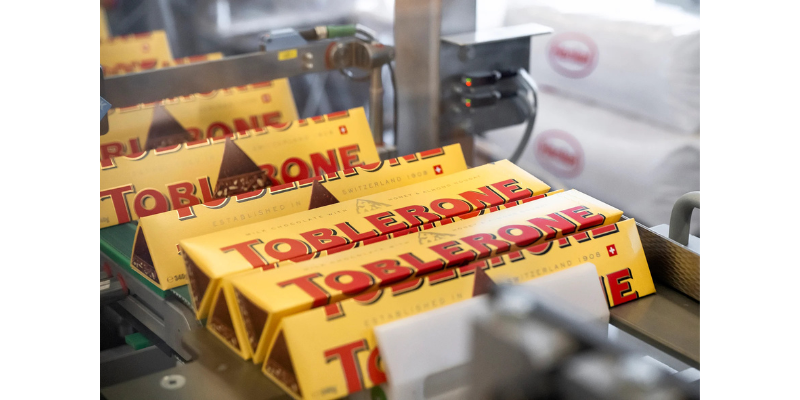
Mondelēz International is bringing Biscoff into another corner of its chocolate portfolio. On September 22, 2026, the company announced the global launch of Toblerone Diamond Truffles with Biscoff, combining Toblerone milk chocolate with Biscoff spread and honey-almond nougat. A 495-gram format will launch exclusively through Costco across ten markets, including the United States, while a smaller sharing format will be available in selected countries. Mondelēz described the Costco rollout as its first global retail partnership with the warehouse retailer.
The product is more than another flavor extension. It represents the continued expansion of the 2024 strategic relationship between Mondelēz and Lotus Bakeries, under which the companies agreed to develop co-branded chocolate products using Biscoff alongside Mondelēz brands. What began publicly with Cadbury and Milka has developed into a broader licensing platform involving additional products, territories and distribution arrangements. For brand owners, that progression illustrates why brand partnership agreements must anticipate what happens after the first successful launch.
The Mondelēz-Biscoff Partnership Has Moved Beyond Its Original Products
Mondelēz and Lotus Bakeries announced their strategic partnership on June 13, 2024. The arrangement had two principal components: Mondelēz would manufacture, market, distribute and sell Biscoff cookies in India under license, while the companies would also develop co-branded chocolates combining Biscoff with Cadbury, Milka and other Mondelēz chocolate brands. The original announcement contemplated Europe first, with the ability to expand globally and into adjacent segments.
The structure has since produced several extensions. Cadbury Dairy Milk with Biscoff launched in the United Kingdom and Ireland, while Milka and Côte d’Or products followed in European markets. In March 2025, Lotus Bakeries also announced that its existing licensing agreement with Mondelēz had been expanded into ice cream through a relationship with Froneri. Beginning in 2026, Froneri would manufacture, market and sell Biscoff ice cream in several European countries, with additional markets contemplated later.
Toblerone now adds another major Mondelēz trademark to that structure. Food Dive reports that the Biscoff platform developed through the Mondelēz relationship is generating more than $300 million in annual revenue, while the company is considering additional applications involving existing brands.
That type of commercial success changes the contractual question. The issue is no longer simply whether two brands can appear together on one chocolate bar. The agreement must support repeated product development without creating uncertainty over which trademarks, markets, formats and channels fall within the permitted scope.
Portfolio Expansion Raises Questions About Future Trademark Rights
The Toblerone launch illustrates an issue that can receive too little attention when brand partnership agreements are negotiated: whether the agreement licenses one identified mark or creates a framework through which additional portfolio brands may later participate.
The 2024 public announcement specifically referenced Cadbury, Milka and “other key” Mondelēz chocolate brands. That language signaled from the outset that the relationship could extend beyond its first products. Toblerone demonstrates what that flexibility can look like commercially.
Contractually, however, portfolio expansion requires more precision than a broad authorization to collaborate. Agreements may need to establish which marks are initially licensed, whether new brands can be introduced through written approval, whether each extension requires a separate statement of work, and whether use in a new product category or territory triggers additional economic terms. A company with dozens of trademarks may be comfortable granting access to selected brands without granting an unrestricted right to its wider portfolio.
Similar questions arise for the licensor. Approval of one co-branded chocolate product does not necessarily mean approval of another formulation, packaging configuration or retail channel. Rights that initially apply to chocolate tablets may need to be reconsidered when the relationship expands into truffles, ice cream, gifting products or other adjacent categories.
That is the legal gap behind successful brand collaborations: agreements designed around the first launch can become restrictive or ambiguous precisely when the partnership begins producing its strongest commercial opportunities.
Trademark Quality Control Continues as the Partnership Scales
Expansion also increases the importance of trademark quality control. Lotus Bakeries has publicly stated that, under the Biscoff licensing arrangement in India, it retains control over Biscoff branding, taste, texture, product specifications and quality, as well as the confidentiality of the recipe. It has also stated that Biscoff’s global brand guidelines, including future guidelines, remain applicable throughout the license scope.
Those provisions illustrate a broader principle of trademark licensing. A trademark owner permitting another company to use its mark generally has a continuing interest in controlling the nature and quality of the goods offered under that mark. As a partnership extends across manufacturing facilities, jurisdictions, packaging formats and product categories, maintaining that control becomes more operationally demanding.
A product such as Toblerone Diamond Truffles with Biscoff involves two established consumer identities on the same package. Decisions involving logo placement, ingredient presentation, visual hierarchy, product naming and advertising can affect both brands. Approval procedures therefore become part of portfolio management rather than a formality handled immediately before launch.
The Costco component adds another layer. The 495-gram package is exclusive to Costco across the United States, Canada, Taiwan, Australia, the United Kingdom, Spain, France, Sweden, Iceland and New Zealand, while the 180-gram format follows a different market strategy. A well-structured agreement must distinguish trademark permission from distribution rights, territorial rights and retailer-specific exclusivity so that one does not inadvertently expand the other.
strategic by design: The Juris Law Group, p.c. Perspective on Brand Licensing
Brand partnerships often begin with a defined product or market opportunity, but the underlying agreement must account for what happens if the collaboration expands. Our brand licensing attorneys in California assess these arrangements with particular attention to preserving trademark ownership and quality control while establishing workable procedures for future products, territories and distribution channels.
The Mondelēz-Lotus relationship illustrates that progression. A licensing structure that extends across multiple brands, product categories and markets requires clear boundaries around the trademarks covered by the agreement, permitted goods, geographic scope, quality standards, marketing approvals, distribution rights and any ability to sublicense. Just as important is the process for bringing a new product or portfolio brand within the relationship after the original agreement has been executed.
Commercial developments can also introduce issues that were not immediate priorities when the parties first negotiated. A retailer may seek exclusivity, a successful product may support expansion into another jurisdiction, or one party may propose bringing an additional trademark into the collaboration. Agreements that anticipate those possibilities can establish amendment, approval and extension procedures before a new opportunity requires the parties to determine their respective rights under time pressure.
The objective is not to restrict future growth. It is to establish where contractual flexibility begins and ends, while preserving the brand controls that made the partnership commercially valuable in the first place.
Strategic Outlook: Brand Partnerships as Long-Term Licensing Platforms
Over the next 12 months, the Toblerone launch will provide another test of how far the Mondelēz-Biscoff platform can extend beyond its original Cadbury and Milka products. Mondelēz has already moved Biscoff across brands and geographic markets, while Lotus has expanded the broader relationship into another category through ice cream. If consumer demand continues to support additional combinations, further portfolio extensions would be consistent with the structure the companies publicly contemplated when their relationship began in 2024.
For the broader CPG sector, the more relevant development may be the evolution of collaboration agreements themselves. Brand partnerships increasingly have the potential to operate as repeatable innovation platforms rather than isolated promotional campaigns. That makes provisions governing future brands, new territories, channel exclusivity and approval rights more consequential at the drafting stage. The first product may establish the relationship, but the agreement must be capable of governing what follows if that product succeeds.
Common Legal Inquiries
What should a brand partnership agreement address when two trademarks appear on the same product?
The agreement should define trademark ownership, permitted uses, product categories, territories, quality standards, packaging and advertising approvals, distribution rights and termination procedures. It should also establish how additional products or uses may be approved if the parties intend the relationship to extend beyond the initial launch.
Can a licensing agreement automatically cover other brands owned by the same company?
That depends on the scope of the agreement. Ownership of several trademarks does not by itself place all of them within a particular license. Agreements can identify specific marks or establish a mechanism for adding additional portfolio brands through approvals, amendments or individual product authorizations.
Why does trademark quality control matter in co-branded food products?
Quality control allows a trademark owner to oversee how its mark is associated with goods produced or marketed through another company. In food and beverage collaborations, that oversight may extend to product specifications, formulation, packaging, manufacturing standards, brand guidelines and marketing materials as the licensed product reaches consumers.