Pejman Javaheri Featured in Restaurant Business on Food Delivery Regulation
Food delivery platforms are under regulatory pressure on several fronts at once. New York City recently reached a $131.5 million settlement with DoorDash over delivery worker pay, and the Federal Trade Commission is considering whether federal rules are needed for the fees charged on online food and grocery delivery platforms.
The two developments involve different legal issues, but they share a theme: regulators are looking closely at how delivery platforms set the terms that affect workers, consumers and restaurants.
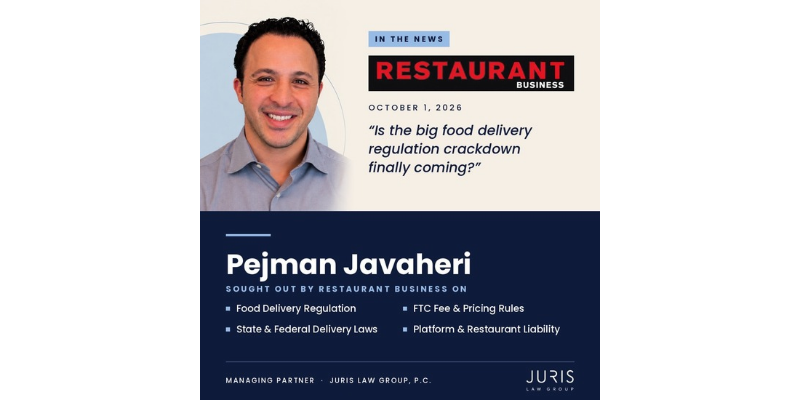
Restaurant Business, the official magazine of the National Restaurant Association, examined that shift in its October 1, 2026 article “Is the big food delivery regulation crackdown finally coming?,” which features commentary from Juris Law Group, P.C. Managing Partner Pejman Javaheri.
“The crackdown is already underway, and it’s coming from several directions at once,” Javaheri told Restaurant Business. “Delivery platforms decide what workers are paid, what fees consumers see, and what contract restaurants sign, and (it appears that) regulators and lawmakers are no longer willing to let the delivery platforms set those terms on their own.”
The open question is whether that oversight will move beyond individual cities and states to the federal level.
DoorDash’s $131.5 Million Settlement Goes Beyond Back Pay
New York City’s settlement with DoorDash shows that delivery regulation can reach well past a monetary penalty.
The city alleged that DoorDash failed to properly compensate delivery workers, including by excluding categories of trip time and on-call time from compensable time and by failing to pay some workers on time. DoorDash agreed to pay $131.5 million, with more than 260,000 workers eligible for payments.
Javaheri points to another part of the settlement that may matter just as much to the industry: DoorDash also agreed to three years of monthly reporting to New York City and to changes to its software.
Those terms turn a one-time enforcement action into continuing oversight of the systems that run the platform. For a technology company operating in many jurisdictions, a local rule can now dictate software design, pay calculations, reporting systems and internal controls.
Javaheri expects that combination of regulation, enforcement and private litigation to grow in importance for delivery platforms. Worker pay is only one part of it.
An FTC Delivery Fee Rule Could Change Enforcement
The FTC’s current inquiry focuses on consumers rather than delivery workers.
In April 2026, the agency began a rulemaking process on fees in online food and grocery delivery. The issues under consideration include whether consumers see the full price early enough in a transaction and whether platforms adequately explain mandatory, variable and other charges.
The difference between what the FTC can do today and what it could do under a delivery-specific fee rule is significant.
The FTC Act already prohibits unfair or deceptive practices. As Javaheri explained to Restaurant Business, however, without a rule directed at the conduct in question, the agency generally must prove that a particular practice is deceptive, case by case, under its existing statutory authority.
A specific rule would set clearer requirements against which a platform’s conduct can be measured, and it would give the agency additional enforcement tools when those requirements are violated.
“The template already exists. The FTC’s Rule on Unfair or Deceptive Fees has been in effect since May 2025, but it only covers live-event tickets and short-term lodging,” Javaheri told Restaurant Business.
The April proceeding is an early step. The public comment period closed on May 18, 2026, but the agency has not proposed or adopted a food delivery fee rule. Javaheri notes that FTC rulemaking requires further stages, including a proposed rule, additional public participation and a final rule supported by agency findings. That process can take years rather than months.
The regulatory pressure does not depend entirely on Washington, however.
State Consumer Laws Could Bring Delivery Fee Claims to Court
One of the less visible risks Javaheri identifies is private litigation.
Consumers generally cannot sue directly under the FTC Act. Many states, however, have their own consumer protection statutes modeled in part on the federal law. These statutes, sometimes called “little FTC Acts,” can give consumers a private right of action and, depending on the state, may support class claims, statutory damages or attorney’s fees.
That creates a different kind of exposure for delivery platforms.
California, for example, generally prohibits advertising or displaying a price that leaves out mandatory charges, subject to specified exceptions. Restaurants and certain other food establishments have a limited ability to list mandatory fees separately when they meet statutory disclosure requirements, but that exception does not apply in the same way to third-party food delivery platforms. We covered the statute in more detail in our article on California’s transparent pricing law.
Other states carry different litigation consequences. New Jersey’s Consumer Fraud Act provides for treble damages in qualifying cases, and New York’s consumer protection statute provides statutory damages and enhanced damages for certain willful or knowing violations. Massachusetts and Illinois direct their courts to consider federal interpretations when applying parts of their own consumer protection laws.
As a result, federal action can matter well beyond FTC enforcement. As Javaheri observed in his full interview, state attorneys general have advocated for a federal standard that acts as a “floor, not a ceiling.” A national rule could set a baseline while states continue to adopt and enforce stronger consumer protections.
It also means the regulatory picture for food delivery may remain fragmented even if the FTC eventually acts.
Restaurants Have Their Own Exposure in Delivery App Disputes
A claim over a delivery or service fee will usually be aimed first at the platform, because the platform typically controls the fees it charges consumers. That does not take restaurants out of the picture.
Javaheri notes that standard merchant agreements allocate responsibility differently depending on what caused the claim. Restaurants commonly supply their menus, item descriptions and prices, while the platform sets its own separate charges.
If a dispute concerns a fee the platform created, the platform is the natural target. If the problem starts with inaccurate menu information, item pricing or other conduct the restaurant controls, the contract may shift some of that responsibility back to the operator.
Indemnification provisions deserve particular attention. Depending on the agreement and the underlying claim, a platform may have a contractual right to seek reimbursement from a restaurant for losses tied to information or conduct for which the restaurant accepted responsibility.
Still, Javaheri does not expect platforms to make that their default response to consumer fee litigation.
“Don’t expect platforms to throw restaurants under the bus,” he told Restaurant Business. “In practice, I would expect a platform to defend a fee claim itself rather than turn on their restaurant partners.”
His full interview adds an important qualification: “But a right to indemnification in a contract is still a right, and restaurants should know it is there.”
For operators, his recommendation is practical:
- Review the delivery platform agreement.
- Pay particular attention to the indemnification provisions.
- Confirm that the menus and prices displayed through the app are accurate.
Larger restaurant groups may also be able to negotiate these provisions rather than accept the standard merchant terms. Our overview of food and beverage contracts discusses the terms that deserve the closest review.
Strategic By Design: The Juris Law Group, P.C. Perspective
Food delivery regulation now connects worker pay, consumer pricing, platform contracts and state consumer protection law. Our food and beverage attorneys approach these issues by asking two questions: who controls the conduct at issue, and how is responsibility allocated between the restaurant and the delivery platform?
Restaurants should not wait for a final FTC rule before reviewing their practices and delivery agreements. Local worker laws, state pricing requirements and existing consumer protection statutes already impose obligations, and the DoorDash settlement shows how far local enforcement can reach.
For delivery platforms, uniform national practices may become harder to maintain as jurisdiction-specific requirements expand and federal oversight develops. As Javaheri told Restaurant Business, the crackdown does not depend on a single federal rule. In several respects, it is already underway.
To discuss how these developments affect your delivery platform agreements or pricing practices, contact Juris Law Group, P.C.
Common Legal Inquiries
1. Is there already a federal rule regulating food delivery fees?
No. The FTC has not adopted a rule specific to food delivery fees. It began a rulemaking process in April 2026 and sought public comment on online food and grocery delivery fees. Several more rulemaking steps are required before any nationwide requirements become final.
2. Can restaurants be responsible for claims involving a delivery platform?
Potentially. Responsibility depends on the conduct involved and on the restaurant’s agreement with the platform. The platform may control delivery and service fees, while the restaurant remains responsible for its menu, item prices and other information it provides. Indemnification provisions can also allocate financial responsibility between the parties.
3. Why would an FTC delivery fee rule matter if states already regulate pricing?
A federal rule could set more specific nationwide requirements and strengthen the FTC’s enforcement options, while state consumer protection laws would continue to provide separate remedies. State officials have advocated for a federal standard that works as a baseline rather than one that prevents states from adopting stronger protections.
This article is for general informational purposes only and is not legal advice.