California Prop 65 enforcement increased in July 2026, with 621 Notices of Violation filed between July 1 and July 31. The month’s activity remained heavily concentrated in lead, cadmium, aflatoxins, phthalates, PFAS compounds, and other chemicals associated with food products, ceramic goods, imported consumer merchandise, plastics, personal care products, and alcoholic beverages.
Lead remained the dominant chemical target by a substantial margin, appearing in 424 notices when lead and lead-compound allegations are aggregated. Ceramic mugs, dishes, decorative products, food items, supplements, powders, cookware, and imported household goods accounted for a substantial portion of these filings. Cadmium appeared in 81 notices, often alongside lead in agricultural products and food.
Retailers and ecommerce platforms continued to occupy a central position in July enforcement. Amazon appeared in 105 notices, and the TJX/HomeGoods/Marshalls group appeared in 96. Target, Walmart, Ross Stores, Sprouts, Albertsons/Vons/Safeway, Kroger/Ralphs, and other major retailers were also named repeatedly, demonstrating that plaintiffs continue to pursue the entities responsible for placing products into the California market even when the underlying chemical issue originates upstream.
Monthly Violation Summary
| Number of Violations | Listed Chemicals | Types of Products Targeted |
|---|---|---|
| 424 | Lead / Lead and lead compounds | Ceramic mugs, tableware, decorative goods, foods, powders, supplements, cookware, imported consumer products |
| 81 | Cadmium / Cadmium compounds | Agricultural products, vegetables, spices, foods, supplements, imported commodities |
| 36 | Aflatoxins | Peanut butter, nuts, oatmeal, snack bars, seeds, agricultural food products |
| 27 | DEHP | Vinyl products, plastic accessories, household goods, consumer-product components |
| 15 | PFOA | Carrying cases, paper goods, wipes, packaging, coated consumer products |
| 14 | Ethyl alcohol in alcoholic beverages | Wine, spirits, and other alcoholic beverage products |
| 13 | Hexavalent chromium | Leather goods, footwear, wallets, gloves, and accessories |
| 8 | Ochratoxin A | Coffee, nut products, grains, and agricultural commodities |
Prop 65 Enforcement Observations — July 2026
July filings reflected a marked concentration in lead-related claims involving ceramic and decorative consumer goods. Mugs, plates, soap dispensers, vases, teacups, serving pieces, and similar products appeared repeatedly. HomeGoods and related TJX entities were frequent notice recipients, often alongside importers, designers, or manufacturers of the underlying merchandise.
The filings illustrate how a single product line can create exposure throughout a distribution chain. A notice may name the importer, the brand owner, and the retailer, even where the alleged chemical is associated with glaze, paint, decoration, hardware, or another component selected by an upstream supplier. Retailers that maintain rapidly changing inventories remain exposed because compliance systems must address hundreds or thousands of products sourced from multiple vendors.
Food-related enforcement also remained prominent. Lead, cadmium, aflatoxins, ochratoxin A, and fumonisin B1 appeared in notices involving powders, dried fruits, nut products, oatmeal, spices, agricultural products, and supplements. These categories present recurring problems because chemical levels may change by supplier, growing region, harvest, storage conditions, and production lot.
Amazon’s appearance in 105 notices reinforces the continuing focus on ecommerce liability. Plaintiffs can identify products, responsible sellers, warning displays, and California availability through public listings. A physical warning placed on the product may not resolve the issue if the online listing fails to present a compliant warning before purchase.
Most Common Chemicals Cited
| Rank | Chemical | Notices |
|---|---|---|
| 1 | Lead | 424 |
| 2 | Cadmium | 81 |
| 3 | Aflatoxins | 36 |
| 4 | DEHP | 27 |
| 5 | PFOA | 15 |
| 6 | Ethyl alcohol in alcoholic beverages | 14 |
| 7 | Hexavalent chromium | 13 |
| 8 | Ochratoxin A | 8 |
| 9 | Retinol | 6 |
| 10 | Delta-9 THC | 5 |
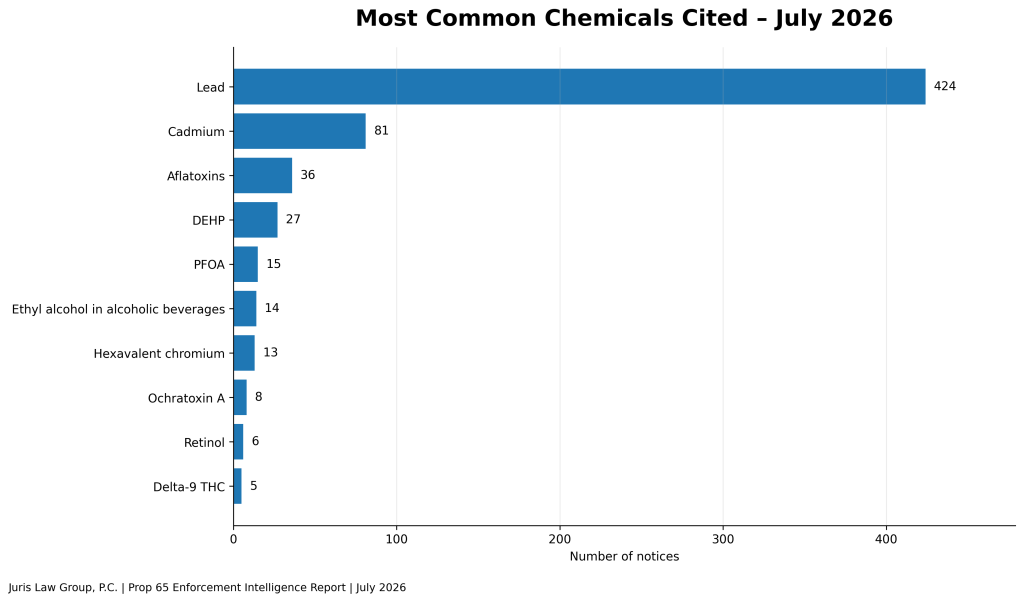
Lead continues to offer plaintiffs the broadest range of potential product targets. It may be alleged in food ingredients, ceramic glazes, paints, coatings, metal components, jewelry, supplements, cookware, and decorative household goods. This broad applicability allows noticing parties to test across categories and pursue multiple entities involved in the same product’s distribution.
Cadmium remained concentrated in food and agricultural products, frequently appearing with lead. Aflatoxin notices focused on agricultural goods susceptible to contamination during growing, harvesting, transportation, or storage. These claims are difficult to manage through specifications alone because results may vary significantly among lots.
DEHP remained the principal phthalate target in plastic and vinyl products. PFOA notices appeared in carrying cases, wipes, paper goods, packaging, and coated products, reflecting continuing enforcement interest in PFAS-related materials despite lower filing volume than lead or cadmium.
Notable Chemical Trends
Lead in Ceramic Mugs and Tableware
Ceramic products were among the most visible targets in July. Notices involved mugs, teacups, plates, pitchers, soap dishes, vases, dispensers, and decorative household items sold through national retailers.
These claims may involve lead in glaze, paint, decorative finishes, rims, handles, or printed designs. Retailers and importers should not assume that a supplier’s general product-safety certification addresses Proposition 65 exposure from ceramic finishes.
Lead and Cadmium in Food Products
Lead and cadmium appeared in dried fruits, powders, supplements, produce, spices, and other agricultural products. These contaminants may result from soil conditions, environmental uptake, processing equipment, or raw-material sourcing.
Testing one production lot does not necessarily establish ongoing compliance. Businesses selling agricultural products need testing programs that account for supplier, origin, harvest, and lot variability.
Aflatoxins in Nuts, Oatmeal, and Snack Products
Aflatoxin filings increased in July and targeted peanut butter, almond butter, nut-based snack bars, oatmeal, seeds, and related food products. Aflatoxins can arise when crops are exposed to mold during growth or storage.
The operational issue is not limited to formulation. Supplier controls, humidity management, storage conditions, certificates of analysis, and periodic verification testing all affect exposure.
DEHP in Plastic and Vinyl Goods
DEHP notices continued to target flexible plastic and vinyl materials. Plaintiffs frequently pursue accessories, household products, protective covers, handles, pouches, and other goods containing softened plastic components.
A product may contain DEHP in a small component rather than its primary material. Compliance reviews should therefore address handles, trims, cords, coatings, grips, straps, and packaging rather than relying exclusively on the product’s principal material description.
PFOA in Coated and Treated Products
PFOA notices involved carrying cases, paper towels, alcohol wipes, and other consumer products that may incorporate coatings or treated materials. These claims show that PFAS-related enforcement is not confined to traditional food packaging or waterproof apparel.
Because PFOA lacks the type of established safe harbor framework available for some other chemicals, defendants may face substantial uncertainty regarding exposure analysis and settlement strategy.
Hexavalent Chromium in Leather Goods
Hexavalent chromium remained active in leather footwear, wallets, gloves, and accessories. These claims commonly arise from leather tanning or finishing practices rather than from product design.
Brands and retailers sourcing leather goods should request information regarding tanning chemistry, restricted-substance testing, material traceability, and corrective procedures where chromium VI is detected.
Alcoholic Beverages as a Recurring Category
Fourteen notices cited ethyl alcohol in alcoholic beverages. These matters differ from contaminant cases because the listed chemical is inherent in the product category.
Alcohol producers, importers, distributors, and retailers must evaluate warning practices across packaging, points of sale, tasting rooms, menus, delivery platforms, and ecommerce channels.
Product Categories Most Frequently Targeted
Ceramics, Tableware, and Home Décor
- Ceramic mugs and travel mugs
- Teacups, saucers, and serving pieces
- Plates, pitchers, and decorative dishes
- Soap dispensers and bathroom accessories
- Vases and painted decorative goods
Food & Beverage
- Peanut butter and almond butter
- Oatmeal and nut-based snack bars
- Dried fruit and botanical powders
- Spices and agricultural commodities
- Supplements and functional powders
- Alcoholic beverages
Plastic and Vinyl Consumer Goods
- Plastic accessories and cases
- Vinyl household products
- Flexible plastic components
- Protective covers and pouches
- Handles, straps, and coated materials
Leather Goods and Accessories
- Wallets
- Boots and footwear
- Gloves
- Belts
- Leather-trimmed accessories
Personal Care and Wellness
- Retinol products
- Products involving diethanolamine
- Supplements and botanical products
- Cannabis and hemp-derived goods
Product Category Table
| Product Category | Enforcement Activity |
|---|---|
| Ceramics / Tableware / Home Décor | Very High |
| Food & Beverage | Very High |
| Agricultural Products / Supplements | High |
| Plastic / Vinyl Consumer Goods | High |
| Leather Goods / Accessories | Moderate |
| Personal Care / Cosmetics | Moderate |
| Alcoholic Beverages | Moderate |
| Cannabis / Hemp Products | Low but recurring |
Top Companies Cited
| Rank | Company / Retail Group | Notices |
|---|---|---|
| 1 | Amazon | 105 |
| 2 | TJX / HomeGoods / Marshalls | 96 |
| 3 | Target | 25 |
| 4 | Walmart | 25 |
| 5 | Ross Stores | 19 |
| 6 | Sprouts Farmers Market | 18 |
| 7 | Albertsons / Vons / Safeway | 18 |
| 8 | Kroger / Ralphs | 13 |
| 9 | Smart & Final | 9 |
| 10 | Whole Foods Market | 7 |
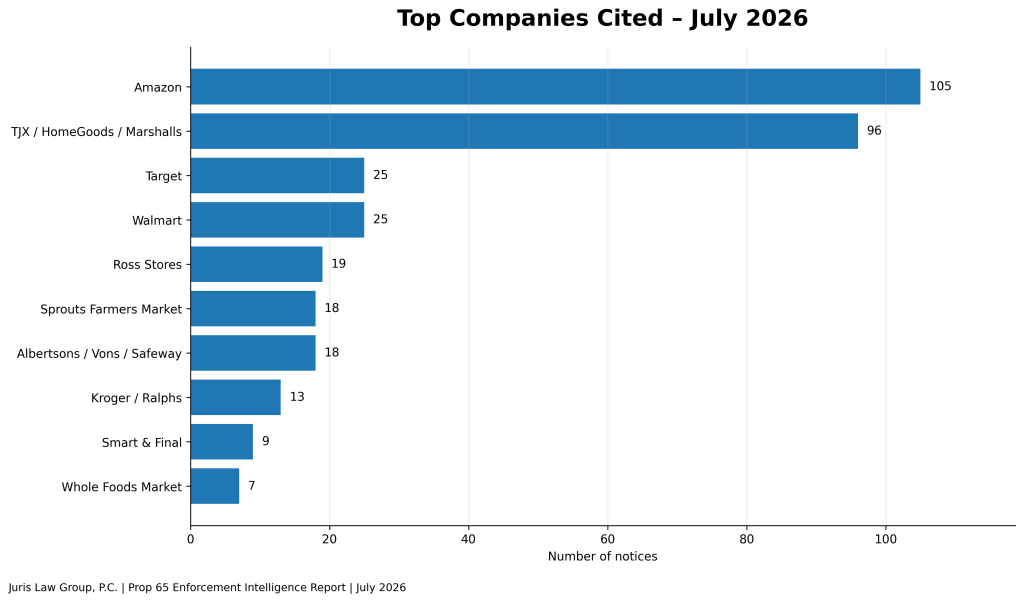
The concentration of notices involving Amazon and TJX-related entities reflects two distinct enforcement models. Amazon represents scalable ecommerce enforcement, where plaintiffs can identify products and warning practices through online listings. TJX and HomeGoods represent high-volume, rapidly changing retail inventories involving imported and third-party merchandise.
Retailers are frequently named alongside manufacturers and importers because the retailer is an identifiable participant in the California sale. Plaintiffs may also view retailers as having stronger incentives to resolve claims quickly, particularly where a product is low-cost, seasonal, discontinued, or sourced through a vendor with limited resources.
The data also shows that grocery retailers remain exposed across food, supplements, agricultural commodities, and private-label products. Sprouts, Albertsons/Vons/Safeway, Kroger/Ralphs, Smart & Final, and Whole Foods all appeared repeatedly.
Top Noticing Parties
| Rank | Noticing Party | Notices |
|---|---|---|
| 1 | Environmental Health Advocates, Inc. | 243 |
| 2 | Center for Consumer Safety, LLC | 94 |
| 3 | CalSafe Research Center, Inc. | 67 |
| 4 | Clean Product Advocates, LLC | 46 |
| 5 | Dennis Johnson | 22 |
| 6 | Gabriel Espinoza | 22 |
| 7 | Ema Bell | 20 |
| 8 | Jay Epps | 14 |
| 9 | Blue Sky Forever | 13 |
| 10 | Ecological Alliance, LLC | 13 |
| 11 | MONARCH | 13 |
July enforcement remained concentrated among a small number of noticing parties. Environmental Health Advocates accounted for 243 filings, representing approximately 39% of all notices filed during the month. Center for Consumer Safety, CalSafe Research Center, and Clean Product Advocates also maintained substantial filing volumes.
The concentration provides useful enforcement intelligence. High-volume noticing parties often develop repeatable testing programs centered on particular chemicals, products, or retailers. When a group identifies a recurring issue in one product, similar goods sold by competing companies may be tested next.
Businesses should monitor noticing-party activity by category rather than reviewing monthly totals alone. A sudden increase by one group in ceramic products, nut products, supplements, or PFAS-treated goods may signal a coordinated testing program that will continue into later months.
Emerging Enforcement Areas
Ceramic and decorative consumer products are likely to remain active targets. July’s concentration in mugs, dishes, and household accessories suggests ongoing testing of imported products sold through off-price and home-goods retailers. Plaintiffs may expand from mugs and tableware into tiles, cookware, planters, bathroom accessories, and seasonal décor.
Aflatoxins and other agricultural contaminants also warrant continued attention. Nut products, grains, spices, coffee, dried fruits, and botanical ingredients remain susceptible to contamination that may vary across suppliers and lots. Increased plaintiff testing in one agricultural category often extends into adjacent food products.
PFAS enforcement remains a lower-volume but high-uncertainty risk. Carrying cases, wipes, coated paper products, textiles, and packaging may provide plaintiffs with additional targets as laboratories expand available testing methods.
Online warning practices will remain a central issue. Ecommerce sellers should expect plaintiffs to review whether warnings appear clearly before purchase, whether product variations are covered, and whether warnings remain attached when listings are updated or syndicated across platforms.
Legal Gap Analysis
One recurring gap is the treatment of decorative finishes as a separate compliance risk. Companies may test the ceramic body of a mug or plate without separately evaluating glaze, paint, metallic trim, decals, or printed designs. July notices show that these secondary materials can drive the claim.
Another gap involves testing frequency for agricultural products. A single passing test may provide limited protection where chemical concentrations change by harvest, supplier, origin, or lot. Businesses need risk-based sampling plans rather than one-time testing.
A third gap involves marketplace listing control. Manufacturers may provide compliant warning language to distributors but lack a process to confirm that the warning appears on Amazon, retailer websites, delivery applications, or third-party listings before purchase.
Retailers also face a documentation gap when products move rapidly through seasonal or opportunistic purchasing channels. Vendor onboarding documents may contain general compliance assurances without identifying specific testing requirements for lead, cadmium, phthalates, PFAS, or other product-specific risks.
Licensor and Private-Label Liability Considerations
Licensors and private-label sellers remain vulnerable when their brand names appear on products or listings, even if manufacturing and sourcing are delegated to third parties. Plaintiffs may name the licensor, licensee, importer, distributor, and retailer in the same notice.
Protective measures should include:
- Proposition 65 warranties tailored to the product category
- Testing requirements for finished products and component materials
- Approval rights over warnings, packaging, and online listings
- Indemnity provisions covering penalties, fees, settlements, and corrective measures
- Insurance requirements that apply to Proposition 65 claims
- Rights to obtain laboratory reports and supplier documentation
- Procedures for recalls, relabeling, and marketplace corrections
Private-label retailers should pay particular attention to products involving ceramics, food, supplements, vinyl, leather, and coated materials. These categories generated substantial July activity and frequently depend on overseas suppliers or multi-tier distribution systems.
Practical Risk Management Considerations
1. Testing Protocols
Testing programs should be based on the risk profile of each product and material. Ceramic goods may require evaluation of glaze and decorative components, while food products may require recurring lot-based testing for heavy metals and mycotoxins.
2. Packaging Review
Product-content testing should be supplemented by review of packaging, labels, coatings, adhesives, trims, and decorative finishes. A compliant formulation does not eliminate packaging or component-based exposure.
3. Warning Language
Warnings should be reviewed across product packaging, websites, retailer portals, marketplace listings, menus, and delivery platforms. A warning that appears only after purchase may not satisfy the applicable requirements.
4. Supplier Agreements
Contracts should assign responsibility for testing, disclosure, warnings, corrective action, indemnity, and document retention. General representations that products comply with all laws provide limited operational guidance.
5. Monitoring Enforcement Activity
Companies should track notices by chemical, product, noticing party, retailer, and supplier. Enforcement patterns often provide advance notice of categories likely to receive additional testing.
6. Counsel Involvement
Early involvement by Prop 65 counsel can help determine whether a company should conduct exposure analysis, obtain additional testing, add warnings, reformulate, pursue indemnity, or challenge the allegations.
The Juris Law Group Perspective on Prop 65 Enforcement
Our Prop 65 attorneys frequently observe that enforcement expands through related products and distribution channels. A plaintiff group may begin with one ceramic mug, food ingredient, or plastic accessory and then test competing products sold through the same retailers or marketplaces.
As CPG attorneys in California, we evaluate notice activity as an indicator of plaintiff strategy rather than as a collection of isolated claims. July 2026 filings point to continued pressure on imported consumer products, ceramics, food and agricultural commodities, ecommerce sellers, private-label programs, and national retailers.
Businesses should treat Proposition 65 as a product-development, sourcing, contracting, and distribution issue. Warning labels are one component of the analysis, but they do not replace testing controls, supplier oversight, ecommerce procedures, and clear allocation of responsibility.
Common Enforcement Inquiries
Can Amazon sellers receive Prop 65 notices directly?
Yes. Marketplace sellers may be named directly, and Amazon may also appear as a notice recipient. Sellers should confirm that compliant warnings appear before purchase, remain associated with all product variations, and are not removed when listings are revised.
Why are ceramic mugs targeted so frequently?
Ceramic mugs may contain lead in glaze, paint, metallic decoration, decals, or printed designs. Imported and decorated ceramics are attractive enforcement targets because they are sold widely through retailers and often involve several upstream suppliers.
Can naturally occurring lead or cadmium still result in a notice?
Yes. A company may assert defenses concerning naturally occurring chemicals or exposure levels, but the presence of a naturally occurring contaminant does not prevent a private party from issuing a 60-day notice.
Are retailers liable for products manufactured by third parties?
Retailers may be named as alleged violators because they sold the product into California. Responsibility may later be allocated through contracts, indemnity rights, or settlement negotiations, but those arrangements do not necessarily prevent the retailer from receiving a notice.
Do online warnings need to appear before checkout?
Generally, the warning must be provided before exposure and before the consumer completes the purchase. Companies should review how warnings display on product pages, mobile applications, marketplace listings, and delivery platforms.
Are food products with passing historical tests protected?
Not necessarily. Heavy metals and mycotoxins may vary among lots, suppliers, harvests, and storage conditions. Historical testing is relevant, but it may not establish the compliance of every later production lot.
Strategic Outlook
July 2026 enforcement data indicates that lead will remain the dominant Proposition 65 target, especially in ceramics, decorative goods, food, supplements, and imported merchandise. Plaintiffs are likely to continue testing products sold by off-price retailers, ecommerce marketplaces, national chains, and specialty grocery stores because those channels provide broad California distribution and identifiable defendants.
Food-related claims involving lead, cadmium, aflatoxins, ochratoxin A, and other agricultural contaminants are also likely to continue. Companies relying on variable raw materials should expect greater pressure to demonstrate supplier qualification, lot testing, traceability, and storage controls.
Retailers, licensors, importers, and private-label companies should also expect plaintiffs to examine secondary product components and sales practices. Decorative glazes, coatings, leather processing, flexible plastics, packaging materials, and online warning displays may become the basis for claims even when the primary product formulation has been reviewed.
The July filings reinforce a broader enforcement pattern: plaintiffs are targeting operational weaknesses across the entire product lifecycle. Companies that coordinate testing, sourcing, contracts, packaging, retail distribution, and ecommerce warnings will be better positioned to identify and address those weaknesses before receiving a notice.
STRATEGIC BY DESIGN: Juris Law Group on Prop 65 Enforcement
Juris Law Group serves as trusted Proposition 65 counsel to manufacturers, retailers, importers, distributors, food and beverage companies, supplement brands, cosmetic companies, cannabis businesses, licensors, and consumer products companies operating in California.
Our services include Proposition 65 compliance programs, product and packaging audits, warning-label strategy, supply-chain reviews, retailer and private-label compliance counseling, settlement negotiations, and defense of 60-day notices and enforcement actions.
Want to Protect Your Brand from a Prop 65 Lawsuit?
To speak with a regulatory attorney or schedule a compliance audit, contact us today: