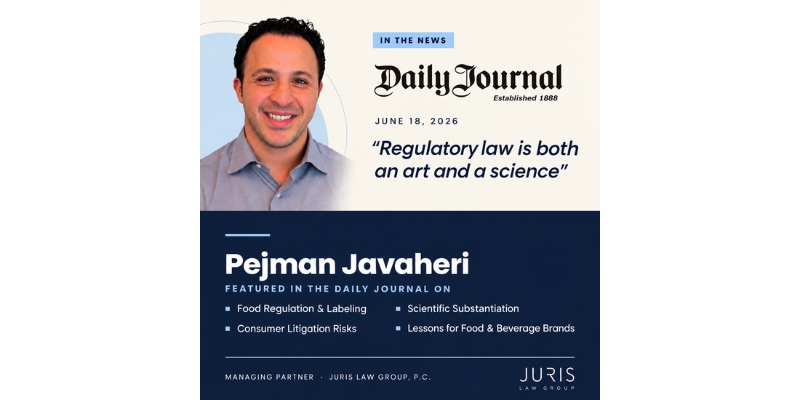
Pejman Javaheri, Managing Partner of Juris Law Group, P.C., authored an article published by the Daily Journal examining what the David Protein lawsuit reveals about the increasingly complex relationship between food regulation, science, labeling, and consumer litigation.
Published in the Daily Journal’s Consumer Protection Law section, “Regulatory law is both an art and a science” examines the 2026 lawsuit challenging the stated calorie and fat content of David Protein bars and the broader lessons it presents for food and beverage companies.
The dispute placed an increasingly common issue at the center of food law: a company can have a reasoned regulatory position and scientific support for its labeling while still facing a consumer lawsuit built around a different testing methodology or interpretation.
David Protein Shows Why Food Labeling Is Not Always Straightforward
The lawsuit alleged that David Protein understated the calorie and fat content of its protein bars. David disputed those allegations, maintaining that the testing behind the claims failed to properly account for esterified propoxylated glycerol, or EPG, a low-digestibility fat substitute used in the products.
The plaintiffs voluntarily dismissed the lawsuit without prejudice in March 2026. The dispute nevertheless illustrates a broader issue for companies developing products with novel ingredients: food science can advance faster than the rules and testing conventions used to evaluate it.
As Javaheri explains in the Daily Journal article, questions about calories, fat, sugar, protein, and similar product attributes can involve more than reading an FDA regulation. Testing methodology, scientific substantiation, regulatory interpretation, and the way consumers understand a claim can all affect a company’s exposure.
FDA Compliance Is Only Part of the Analysis
One of the article’s central lessons is that technical compliance does not necessarily prevent a lawsuit. Food and beverage brands also operate under state consumer protection laws and face claims based on how reasonable consumers may interpret labels and advertising.
That distinction becomes more important when a product relies on unfamiliar ingredients or technology. A scientifically sound position may still be difficult to communicate to consumers, retailers, regulators, or a court if the reasoning behind a claim is highly technical.
For that reason, companies making nutrition and performance claims should consider how those claims would withstand scrutiny outside the product-development process. Reliable testing, documented scientific support, and consistency between regulatory, scientific, legal, and marketing teams can become particularly important when a claim is challenged.
Scientific Substantiation Can Become a Business Asset
The David Protein dispute also demonstrates why substantiation should be developed before litigation arises. When a claim becomes the subject of a lawsuit, the company may need to explain not only what the label says, but how the underlying number was calculated and why the methodology is defensible.
That preparation has consequences beyond the courtroom. Nutrition claims often form part of a product’s commercial identity, particularly for brands built around high protein, reduced sugar, fewer calories, or other measurable attributes. A challenge to the science behind those claims can therefore become a challenge to the brand itself.
Javaheri’s analysis emphasizes preparation: sound regulatory analysis, defensible testing protocols, documentation supporting product claims, and coordination among the teams responsible for the product and its public messaging.
Read Pejman Javaheri’s article in the Daily Journal