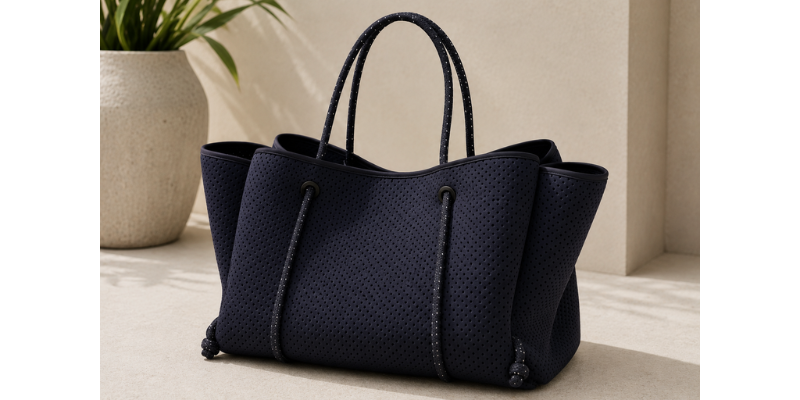
Naghedi’s effort to secure federal trademark protection for its woven neoprene handbag design has become a closely watched test of how far U.S. trademark law extends over fashion product patterns. In a May 12, 2026 non-final Office Action, the U.S. Patent and Trademark Office again refused registration for the company’s repeating woven neoprene design, finding that consumers are likely to perceive the pattern as ornamentation rather than as a source identifier.
The dispute places Naghedi at the center of a broader tension facing fashion and accessories brands: whether a commercially successful product aesthetic can evolve into protectable trade dress when the same visual language has become common across the market. The USPTO’s position suggests that widespread imitation may undermine, rather than strengthen, a claim that consumers associate the design exclusively with a single brand.
Naghedi, through Entrelaced Holdings LLC, filed U.S. Trademark Application No. 97791699 in February 2023 seeking protection for the woven neoprene configuration used across its handbag portfolio. The company argued that years of sales, media exposure, celebrity visibility, and market copying established acquired distinctiveness. The USPTO nevertheless maintained that the design functions primarily as decorative product styling. That distinction carries consequences extending beyond this application, particularly for fashion companies attempting to convert viral aesthetics into enforceable trademark assets.
USPTO Refusal Targets Naghedi’s Repeating Woven Pattern as Ornamentation
The USPTO’s refusal focuses on a recurring issue in fashion trademark prosecution: whether a repeating pattern covering the surface of a product functions as a trademark at all. Examining attorneys repeatedly cited third-party woven handbag designs from luxury brands, independent labels, and marketplace sellers to argue that consumers are accustomed to viewing woven bag patterns as product decoration rather than as indicators of source.
The Office Action reflects the USPTO’s increasing scrutiny toward repeating-pattern applications in apparel and accessories. Product design trade dress cannot be inherently distinctive under the Supreme Court’s decision in Wal-Mart Stores, Inc. v. Samara Brothers. A brand seeking protection must instead prove acquired distinctiveness, meaning consumers identify the design itself with a single commercial source.
Naghedi attempted to satisfy that burden by emphasizing the commercial recognition of its woven neoprene bags and the volume of alleged “dupes” in the market. The USPTO rejected the argument that copying alone establishes trademark significance. According to the examining attorney, competitors may imitate a successful aesthetic because consumers find the style desirable, not because consumers associate the design with a specific company.
That distinction creates a legal gap many fashion brands underestimate. Consumer demand for a product appearance does not necessarily translate into trademark significance under the Lanham Act. In product design disputes, courts and the USPTO often separate popularity from source identification, particularly where the design feature remains aesthetically functional or widely used throughout the category.
Fashion Trade Dress Claims Face Higher Evidentiary Pressure After Viral Product Success
Naghedi’s application arrives at a time when fashion companies increasingly attempt to protect recognizable product configurations through trademark law rather than copyright or patent filings. Social commerce and rapid product duplication have accelerated interest in trade dress enforcement because trademark rights can theoretically last indefinitely if the design continues functioning as a source identifier.
The problem for many brands is that commercial success can simultaneously weaken exclusivity arguments. Once a design language becomes broadly adopted within a category, the USPTO may view the aesthetic as a trend rather than a brand indicator. The agency’s citations to Bottega Veneta-inspired woven bags illustrate how market saturation complicates claims of distinctiveness, even where a particular brand helped popularize the look.
Naghedi also faces the structural challenge associated with protecting texture and pattern-based configurations. Repeating designs covering the entirety of a product often trigger what trademark examiners call the “wallpaper effect,” where consumers perceive the design as ornamental surface decoration. The more extensively a pattern covers the goods, the more difficult it becomes to demonstrate that consumers view it as branding.
The refusal may also affect future enforcement positioning. Even absent registration, Naghedi could continue asserting common law trade dress rights. However, an adverse USPTO record identifying the design as ornamental may become persuasive material in future litigation involving alleged knockoffs or false designation claims.
The Legal Exposure Around “Dupe Culture” and Consumer Perception Standards
The case also intersects with the fashion industry’s expanding “dupe” economy. Companies increasingly rely on viral product visibility to build consumer demand, while competitors release lower-cost versions that mimic the underlying aesthetic without using protected logos or names.
Naghedi’s prosecution strategy effectively argued that imitation demonstrated consumer recognition. The USPTO’s response highlights a recurring enforcement problem in fashion trademark disputes: copying behavior does not automatically establish likely confusion. Under trademark law, the central inquiry remains whether consumers associate the design with a single source rather than whether competitors found the design commercially attractive.
This distinction matters because many fashion enforcement campaigns increasingly depend on implied association theories rather than direct logo copying. Brands pursuing trade dress claims must often produce evidence such as consumer surveys, unsolicited media recognition, advertising emphasizing the design feature itself, and long-term exclusive use.
The USPTO’s continued refusal also reinforces how difficult it is to secure trademark rights over minimalist or design-forward aesthetics without a separate branding element. Fashion companies attempting to protect silhouettes, stitching patterns, woven constructions, or repeating textures face higher evidentiary pressure where the feature serves both aesthetic and commercial functions.
The Juris Law Group Perspective on Fashion Trade Dress and Trademark Enforcement
Fashion brands increasingly treat product configuration and surface design as part of long-term portfolio management rather than short-term marketing strategy. Companies often pursue trade dress protection only after a product achieves commercial momentum, which can create evidentiary complications if the design has already become widely replicated throughout the market.
Our trademark attorneys frequently assess whether a product feature has been consistently promoted as a source identifier or simply presented as product styling. Consumer perception evidence, advertising language, retailer presentation, and exclusivity history generally carry more weight than raw sales figures when enforcement disputes emerge. That analysis becomes particularly important in fashion categories where visual trends spread rapidly across marketplaces and social media channels.
The Naghedi matter also reflects how trademark protection lawyers evaluate overlap between brand positioning and product aesthetics before enforcement activity begins. Where a design element functions as the core identity of the product itself, companies often require layered protection strategies involving trademarks, design patents, unfair competition claims, and marketplace enforcement rather than reliance on a single IP theory.
What the Next 12 Months Could Mean for Naghedi and Fashion Trademark Enforcement
Naghedi still has an opportunity to respond because the latest Office Action is non-final. The company may submit additional evidence attempting to prove acquired distinctiveness, including consumer survey data, expanded declarations, advertising expenditures, and media recognition focused specifically on the woven neoprene configuration. A narrowed application strategy or Supplemental Register approach may also become part of the prosecution discussion.
The broader fashion category is likely to watch the matter closely because the outcome may influence how brands approach repeating-pattern filings moving forward. Companies that built recognition through social media aesthetics rather than logo-centric branding may face increasing resistance when attempting to convert those visual identities into registered trademark rights.
Over the next year, the dispute may also shape how brands frame anti-dupe enforcement campaigns. The USPTO’s reasoning suggests that widespread copying can undermine exclusivity arguments where the copied feature primarily functions as ornamentation. That creates additional pressure on brands to establish consumer association earlier in a product lifecycle before the aesthetic becomes normalized across the market.
The case also reflects a larger shift in trademark examination involving fashion and consumer products. As minimalist branding strategies continue expanding, the USPTO appears increasingly willing to question whether consumers actually perceive product design features as trademarks. For companies building brand equity around texture, configuration, or repeating patterns, the evidentiary burden surrounding acquired distinctiveness is becoming harder to satisfy after a product aesthetic reaches mainstream saturation.
Common Legal Inquiries
Can a handbag design qualify for trademark protection?
Yes. A handbag design may qualify as trade dress if consumers associate the design with a single commercial source. The applicant must usually prove acquired distinctiveness through extensive use, advertising, media recognition, and consumer perception evidence.
Why did the USPTO refuse Naghedi’s trademark application?
The USPTO determined that consumers are likely to view the woven neoprene pattern as decorative product styling rather than as a trademark identifying source. The agency also cited widespread use of similar woven bag aesthetics across the market.
Does copying by competitors prove trademark rights?
Not necessarily. Trademark law focuses on whether consumers identify the design with one source. Competitors may copy a commercially successful style because it is aesthetically appealing, which does not automatically establish acquired distinctiveness or likelihood of confusion.