The Kroger Co. and its subsidiary, Ralphs Grocery Company, are facing a new legal challenge in California regarding the transparency of their meat-labeling practices. On March 20, 2026, the advocacy group Animal Outlook filed a complaint in the Los Angeles County Superior Court (Case No. 26TRCV01040), alleging that the retailers have misled consumers through deceptive point-of-sale signage.
While a formal press announcement was issued on April 9, 2026, court records confirm the litigation commenced in late March. The complaint targets specific marketing language used in Ralphs stores, asserting that the retailers are “humane-washing” conventional factory-farmed products to command a premium price.
Allegations of Deceptive In-Store Signage
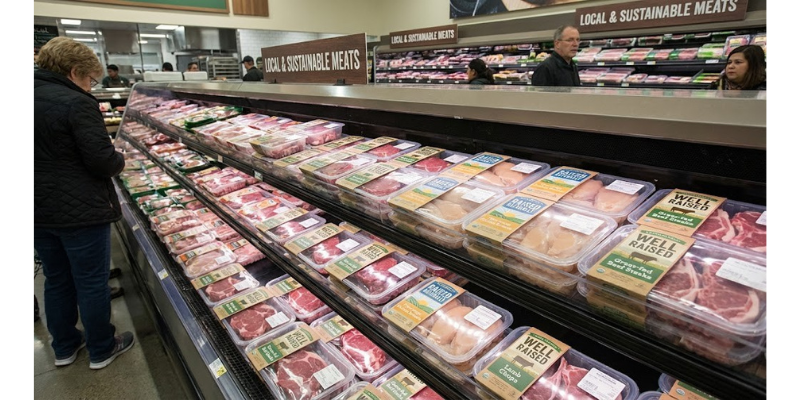
The core of the dispute involves overhead signage and meat counter displays. According to the complaint, certain Ralphs locations utilized signage featuring phrases such as “raised naturally,” “no antibiotics,” and “no added hormones” positioned above various meat cases. Additionally, the suit alleges that “well raised” signs were placed above select meat counters.
Animal Outlook contends that these claims create a false impression of superior animal husbandry. The complaint alleges that products sold under these banners often originate from standard commercial farming operations that do not meet the welfare standards consumers expect when presented with such terminology.
The lawsuit specifically cites violations of California’s False Advertising Law and Unfair Competition Law. The plaintiff is seeking injunctive relief to force the removal of the signs or ensure the products sold beneath them actually adhere to the stated claims.
Discrepancies in Animal Welfare Standards
A critical component of the litigation is the alleged gap between Kroger’s public animal welfare policies and its in-store marketing. The complaint notes that while Kroger has established broiler-chicken welfare goals for its premium “Simple Truth Organic” and “Simple Truth Natural” lines—including requirements for space and humane slaughter—these standards do not appear to apply to the regular private-label products often found under the “well raised” signage.
Furthermore, the lawsuit alleges that Kroger currently maintains no formal animal welfare standards for its beef suppliers. This lack of a baseline protocol for beef products forms a primary basis for the claim that “well raised” and “raised naturally” descriptors are technically unsubstantiated within the defendants’ supply chain.
Historical and Regulatory Context in California
This is not the first instance of litigation between these parties. In 2014, Kroger settled a similar federal case in California brought by the same organization (then known as Compassion Over Killing). That settlement resulted in Kroger removing the “raised in a humane environment” claim from its Simple Truth chicken packaging, although the company maintained the claim was accurate at the time.
More recently, Kroger has faced unrelated California litigation over labeling, including a May 2024 civil case regarding calorie counts on its Carbmaster bread. These repeated challenges underscore the heightened legal scrutiny faced by major retailers in the California market, where consumer protection statutes are particularly robust.
The Juris Law Group Perspective on CPG Litigation
Our IP attorneys frequently navigate these enforcement challenges where “soft” marketing terms -like “naturally raised”- are treated by plaintiffs as concrete, verifiable claims. In the current environment, “humane-washing” allegations are increasingly paired with references to federal guidance.
For instance, the USDA recently reported finding antibiotic residues in approximately 20% of samples from the “Raised Without Antibiotics” market. While this finding does not prove the specific allegations against Ralphs or Kroger, it provides the technical backdrop that trademark protection lawyers and licensing counsel use to argue that voluntary marketing claims require more rigorous third-party substantiation.
Strategic Outlook: Anticipated Outcomes and Risk Mitigation
The trajectory of Animal Outlook v. Ralphs Grocery Company will likely be defined by the “reasonable consumer” standard, a cornerstone of California consumer protection law. Given the 2014 settlement history between these two parties, a quiet resolution is a distinct possibility; however, the specific focus on in-store signage rather than product packaging introduces new variables for the defense.
Expected Litigation Turnout
In the immediate term, expect the defendants to challenge the standing of the plaintiff and the specificity of the “humane-washing” claims. If the case proceeds past the pleading stage, the discovery phase will likely focus on whether Kroger’s internal supply chain audits can substantiate the “well raised” and “raised naturally” descriptors used at the point of sale.
If the court finds that the overhead signage lacks a specific, verifiable definition, the most probable outcome is a settlement involving a remedial injunction. This would require the defendants to either remove the contested language or implement a clear, tiered labeling system that explicitly defines what “well raised” means in the context of their specific supply chain standards.
Risk Mitigation for Brands
CPG brands should adopt a “compliance by design” model to reduce exposure to costly false advertising litigation, aligning marketing claims with verifiable supply chain data. This approach starts with a formal internal index defining subjective terms like “naturally raised,” supported by third-party audits or recognized government standards.
Legal teams can also conduct physical retail audits to address the “halo effect,” where broad signage over mixed inventory creates misleading impressions. Replacing aspirational language with precise, product-specific claims helps eliminate information gaps that attract plaintiff scrutiny. Leveraging external certifications provides an added layer of protection by shifting the evidentiary burden to independent authorities. Aligning sustainability goals with in-store execution remains critical to navigating California’s aggressive consumer protection framework.
Common Legal Inquiries
What are the primary statutes cited in California “humane-washing” cases?
Most plaintiffs rely on the False Advertising Law (FAL) and the Unfair Competition Law (UCL). These statutes allow for private and representative actions when marketing is “likely to deceive” a reasonable consumer, even if the statements are not technically false in a narrow, literal sense.
Can a retailer be held liable for claims made on signage rather than product labels?
Yes. California law does not distinguish between a product label and the environment in which it is sold. If a sign located above a meat case leads a consumer to believe all products within that case share a specific attribute, the retailer may be liable for deceptive trade practices.
What is the significance of the 2024 USDA antibiotic residue report for these lawsuits?
While the report is not a legal ruling, it provides a “reasonable basis” for plaintiffs to challenge the veracity of “no antibiotic” claims. It signals to the court that such claims are high-risk and may require retailers to provide specific testing data during the discovery phase of a lawsuit.