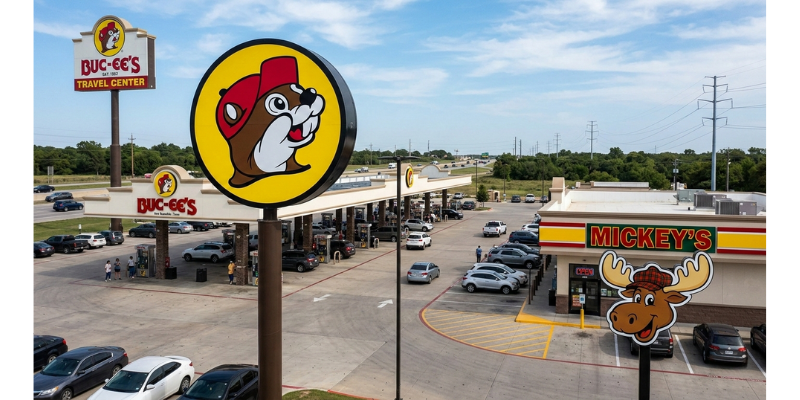
On February 18, 2026, Texas-based convenience store and travel center giant Buc-ee’s filed a federal lawsuit against Ohio gas station chain Mickey’s (formerly known as Mickey Mart), alleging that Mickey’s branding infringes on its trademark rights. The filing claims the Ohio chain’s recent rebrand — especially its moose mascot and logo design — is confusingly similar to Buc-ee’s iconic Bucky the Beaver logo and name, potentially misleading consumers about the relationship between the companies.
What Buc-ee’s Argues Is Too Close for Comfort
The lawsuit focuses on several specific elements of Mickey’s updated identity:
- Mascot Design: Mickey’s current logo shows a wide-eyed cartoon moose facing right inside a red hexagonal shape. Buc-ee’s argues this is visually similar to its own smiling beaver, also facing right and set against a bold background, which it has used for decades.
- Color and Shape Influences: While Buc-ee’s typically uses its yellow circle backdrop, Mickey’s red hexagon and use of bold reds in signs and uniforms are part of what Buc-ee’s describes as an effort to trade on Buc-ee’s recognizability.
- Name Shift: Buc-ee’s also calls out the Ohio chain’s move from “Mickey Mart” to “Mickey’s,” claiming that dropping the word “Mart” and leaning into the possessive form makes the name audibly resemble “Buc-ee’s.”
In its complaint, Buc-ee’s asserts that these elements taken together increase the “likelihood of confusion” among consumers who may mistakenly think the two companies are affiliated.
Behind the Court Action: Legal Grounds and Remedies Sought
The lawsuit, filed in the U.S. District Court for the Northern District of Ohio, brings claims under federal trademark law, specifically alleging:
- Trademark infringement
- Unfair competition
- Cancellation of Mickey’s trademark registrations
Buc-ee’s is seeking both damages and an order preventing Mickey’s from continuing to use the contested logo and name in commerce, as well as cancellation of trademark registrations that the Ohio company secured beginning in late 2025.
Legal experts often note that under the Lanham Act (the primary federal trademark statute), the central question isn’t whether the logos are identical, but whether the similarities are sufficient to cause consumer confusion given the goods/services and typical buyers. In trademark disputes involving consumer-facing retail brands, courts weigh multiple factors such as strength of the original mark, similarity of the marks, channels of trade, and evidence of actual confusion. This case will test those factors in a rivalry that now involves national expansion.
Why This Lawsuit Matters Now
Several context points deepen the significance of this legal battle:
Buc-ee’s Growing Footprint Outside Texas
Buc-ee’s began in 1982 in Clute, Texas, and built a reputation for large travel centers, distinctive branding, and enthusiastic customer loyalty. Its expansion beyond Texas accelerated in the late 2010s and early 2020s, with stores opening in states like Alabama, Florida, and Kentucky. As of mid-2025, Buc-ee’s operated 54 locations nationwide.
Importantly, Buc-ee’s plans to open its first Ohio travel center in April 2026, just weeks after this lawsuit was filed. One trademark attorney quoted by local news suggests the timing is strategic: once Buc-ee’s enters a new state market, preventing confusingly similar local brands becomes more urgent to protect customers and trademark rights.
Not the First “Mascot Dispute” Buc-ee’s Has Pursued
This isn’t Buc-ee’s first run-in over branding. Previous actions include litigation or threats of litigation against businesses with animal mascots or similar logo treatments such as:
- Super Fuels, a North Texas chain with a cartoon dog in a circle.
- Duckees Drive-In in Missouri, featuring a duck mascot that settled and dismissed the case.
- Apparel and merchandise sellers that used Buc-ee’s beaver imagery without authorization.
The company’s legal history shows a pattern of vigorously defending its trademark portfolio, sometimes years before a large incumbent brand enters a new geographic area.
What Comes Next in the Legal Fight
At this early stage, the case will unfold in two parallel arenas:
- Federal Court Litigation: Mickey’s (through its parent Coles IP Holdings) will have the opportunity to answer the complaint, potentially filing motions to dismiss or to narrow the claims. Discovery and briefs on likelihood of confusion are expected if the case proceeds.
- Trademark Trial and Appeal Board (TTAB): Buc-ee’s also challenged Mickey’s trademark registrations administratively at the TTAB, seeking cancellation — a separate proceeding that may hinge on similar legal questions about distinctiveness and confusion.
What neither side has publicly offered in detail yet are factual examples showing actual consumer confusion on the ground — something courts consider heavily. Alleged confusion on social media or in comments may be used as evidence, but formal surveys or documented instances often carry more weight in litigation.
Implications for Brands and Local Operators
While this case centers on two well-known convenience store chains, the broader legal relevance reaches beyond — especially for regional and independent brands:
- Trademark enforcement is a strategic business tool. Once a mark becomes famous, failing to police similar uses can weaken its scope under U.S. law.
- Visual trademarks and names can be protected together. Even if the names aren’t identical, similarities in graphic style, color schemes, and mascot presentation can trigger legal disputes.
- Expansion into new markets invites scrutiny. As national brands push into new states, overlapping consumer bases raise the stakes for local chains that use emotive branding.
Frequently Asked Questions (FaqS)
Is Buc-ee’s already operating in Ohio?
No. Buc-ee’s has announced plans to open its first Ohio location in 2026. The lawsuit was filed shortly before that expansion.
What does “likelihood of confusion” mean?
It is the legal standard for trademark infringement under the Lanham Act. Courts ask whether ordinary consumers would likely believe two brands are affiliated based on similarities in name, logo, industry, and marketing channels.
Can a mascot be protected as a trademark?
Yes. Mascots and logos are protectable if they identify the source of goods or services. A similar cartoon character used in the same industry can raise infringement claims.
What remedies can a court order in a trademark case?
A court may require a business to stop using the mark, cancel trademark registrations, and in some cases award damages or profits. Many cases resolve through settlement and rebranding.
Trademark Enforcement and Brand Protection
Trademark disputes often arise when companies expand into new markets or update branding. Early clearance and enforcement strategy can prevent costly litigation.
At Juris Law Group, P.C., we advise food, beverage, retail, and CPG brands on trademark registration, opposition proceedings, enforcement actions, and federal litigation. Strategic protection at the right stage of growth helps preserve long-term brand value.