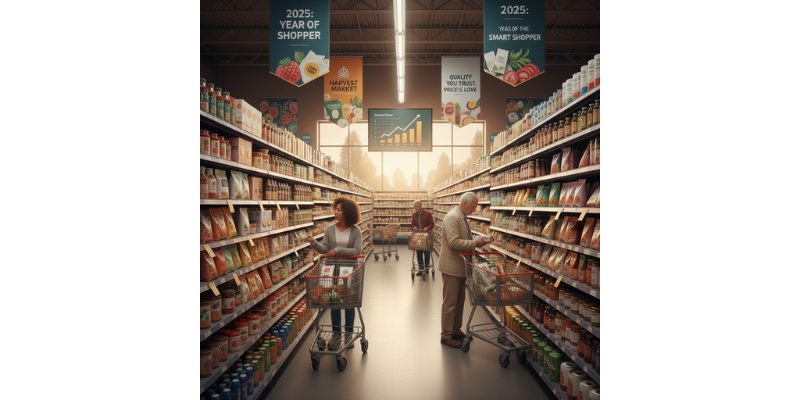
Private-label grocery sales hit an all-time high in 2025, growing faster than national brands in both dollars and units. This isn’t a temporary inflation blip. It’s a structural shift in how retailers compete, how consumers shop, and how food brands protect their shelf position.
The Ground Has Moved
Private label used to live at the bottom shelf. Plain packaging. Low expectations.
That’s over.
In 2025, store brands posted their strongest performance on record. Retailers didn’t just benefit from price-sensitive shoppers. They took share. Real share. And they did it in categories where national brands once assumed loyalty would hold.
It didn’t.
How Large Did Private-Label Sales Get in 2025?
Big enough to reset assumptions.
U.S. private-label grocery sales reached roughly $282.8 billion in 2025, according to PLMA and Circana (formerly IRI). That translates to about 3.3% dollar growth year over year, nearly triple the growth rate of national brands, which hovered closer to 1.2%.
Unit volume tells the sharper story.
- Private-label unit sales increased.
- National-brand unit volume declined.
PLMA summarized it plainly:
“Private label dollar sales in the United States rose 3.3% in 2025 to a record $282.8 billion, with unit sales also increasing while national brand unit volume declined.”
(Source PLMA / Circana, via Grocery Dive.)
When volume shifts this way, it’s no longer just about price. It’s about preference.
Over the last five years, private-label sales are up roughly 30%, pushing store brands past 21% of total grocery dollar share. That level used to feel out of reach in the U.S. market.
Which Grocery Categories Are Driving the Gains?
Not just pantry staples. That’s the part people miss.
Categories Leading Private-Label Growth
- Refrigerated foods
- Beverages, including functional and better-for-you lines
- Frozen foods
- Pet food and pet care
- Health, beauty, and household essentials
Refrigerated foods stand out.
Private-label refrigerated meals—think ready-to-heat entrees, prepared salads, and fresh grab-and-go items—posted the largest dollar gains of any store-brand category in 2025, growing at roughly 6% year over year. That matters because refrigeration is expensive, operationally complex, and historically brand-driven.
Retailers don’t push private label that hard unless they’re confident shoppers will come back for it.
Which Retailers Are Pushing Private Label the Hardest?
The ones treating it like a core asset, not a fallback.
Private-Label Share by Retailer
- Aldi: roughly 80% of sales
- Trader Joe’s: close to 70%
- Costco (Kirkland Signature): about 34%
- H-E-B and Sam’s Club: around 33%
- Walmart: roughly 30%
- Target: about 23%
What’s changed isn’t just penetration. It’s structure.
Most large retailers now run multi-tier private-label portfolios—entry price, core, premium, organic, and lifestyle-driven lines—that mirror national brand architecture almost exactly.
Are Consumers Still Choosing Private Label Only on Price?
No. And that’s the inflection point.
Price opened the door. Quality kept it open.
Private-label products now compete credibly on:
- Ingredient decks and clean-label positioning
- Taste and performance parity
- Packaging and shelf presence
- Speed to market for trend-driven SKUs
Higher-income households noticed. Data shows increased private-label adoption even among shoppers earning over $100,000, a group that historically resisted store brands.
Once that group switches, it rarely switches back.
How Does This Change the Competitive Math for National Brands?
It tightens everything.
Shelf space gets scarcer. Price gaps narrow. Retailers gain negotiating leverage. And look-alike timing accelerates.
That pressure shows up fastest in categories where:
- Packaging cues do a lot of the differentiation work
- SKUs compete inside narrow price bands
- Innovation cycles are short
National brands aren’t just competing with each other anymore. They’re competing with the store itself.
Where Do Legal and IP Risks Start to Creep In?
Right where speed meets similarity.
As private-label portfolios expand, so do disputes involving:
- Trade dress overlap
- Packaging look-alikes
- Trademark clearance failures
- Co-packing conflicts where manufacturers serve both sides
Retailers now behave like brand owners. That changes the litigation landscape, especially in food, beverage, and pet categories where visual identity carries real weight.
How Are Retailers Using Private Label Internally?
As a control mechanism.
Private label allows retailers to:
- Protect margins when branded pricing rises
- Set category price ceilings
- Fill innovation gaps faster than legacy CPGs
- Reduce reliance on national-brand promotions
In many chains, store brands now anchor category resets. National brands follow.
The Issues That Surface After the Sale
Sales numbers are easy. Consequences aren’t.
Strong coverage also has to account for:
- How private label reshapes retailer bargaining power
- Why refrigerated and regulated categories outperform dry grocery
- The legal strain created by fast store-brand expansion
- Supplier risk when manufacturers play both sides of the shelf
That’s where the real pressure shows up.
What Should Food and Beverage Companies Be Doing Right Now?
Watching more closely. Assuming less.
Practical steps include:
- Auditing trade dress and packaging defensibility
- Monitoring private-label launches in adjacent SKUs
- Reviewing co-manufacturing and exclusivity language
- Stress-testing pricing strategies against store-brand ceilings
At Juris Law Group, these issues tend to surface first in packaging disputes, supplier agreements, and clearance work—long before they land in court.
Frequently Asked Questions (FAQ)
Is private-label growth expected to continue into 2026?
Early indicators suggest yes, particularly in refrigerated foods, beverages, and pet categories where retailers are expanding premium store-brand lines.
Are private labels really matching national brands on quality?
In many categories, they already are. Formulation gaps have narrowed, and perception is catching up quickly.
Are national brands losing shelf space permanently?
In some categories, yes. Once a retailer resets around its own brand, displacement can become sticky.
Does private label increase legal exposure for brands?
It can. Packaging similarity, trademark expansion, and shared manufacturing relationships raise the risk profile.
Key Takeaway
Private label isn’t catching up. It already has.
Retailers now own brands that compete head-to-head with national food and beverage companies on price, quality, and placement. Companies that still treat store brands as a short-term inflation response are already behind.