California is once again pushing the boundaries of food regulation—this time with a proposal that could reshape how consumers evaluate what’s on grocery store shelves.
A new bill aims to introduce a “non-ultra-processed” food label, signaling a shift away from simply regulating ingredients toward influencing how products are perceived at the point of purchase. If enacted, it would mark one of the first statewide efforts to formally distinguish minimally processed foods from heavily industrialized ones.
A New Layer of Food Transparency
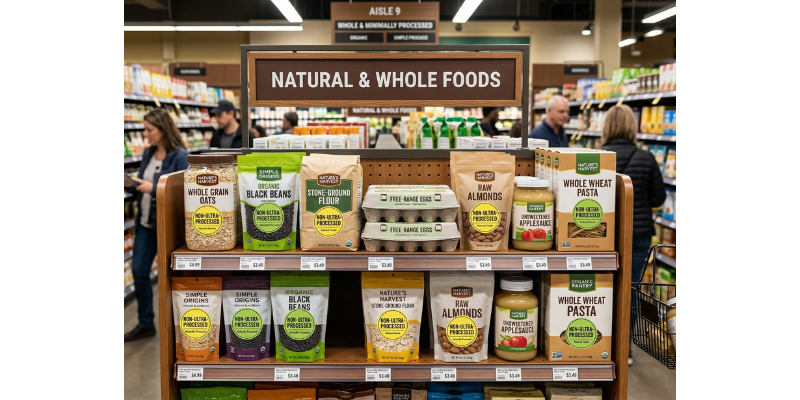
The proposed labeling system would allow qualifying products to carry a state-recognized designation indicating they are not ultra-processed. Similar to “organic” or “non-GMO,” the label would rely on defined standards and third-party certification.
The intent is straightforward: give consumers a faster, clearer way to identify foods that are closer to their original, whole form.
Unlike traditional nutrition labels, which require interpretation, this approach simplifies decision-making into a visual cue—something policymakers believe modern shoppers increasingly rely on.
The Rise of Ultra-Processed Food Concerns
The proposal is rooted in growing scrutiny around ultra-processed foods (UPFs), a category that has expanded rapidly over the past several decades.
These products are typically:
- Industrially manufactured
- Formulated with additives such as preservatives, flavor enhancers, and stabilizers
- Designed for shelf stability, convenience, and hyper-palatability
Today, ultra-processed foods make up a significant share of the average American diet. Public health advocates have linked high consumption levels to chronic conditions such as obesity, metabolic disorders, and cardiovascular disease—though the strength and causality of these connections remain debated.
Still, the momentum behind reducing reliance on heavily processed foods continues to build across both policy and consumer landscapes.
Why California Is Taking the Lead
California has consistently positioned itself at the forefront of food policy reform. Recent initiatives have included:
- Restrictions on certain food additives and synthetic dyes
- Efforts to limit ultra-processed foods in school meal programs
- Increased focus on ingredient transparency
The proposed label represents the next phase: influencing consumer behavior directly at the retail level.
Rather than removing products from the market, the strategy shifts toward market signaling—rewarding products that meet a new standard and allowing consumer demand to drive change.
The Definition Problem
At the center of the debate is a fundamental challenge: what qualifies as “ultra-processed”?
There is no universally accepted definition.
Different classification systems evaluate factors such as:
- Degree of industrial processing
- Type and purpose of added ingredients
- Structural changes to the original food
As a result, some foods widely perceived as healthy—like certain yogurts, packaged whole-grain breads, or plant-based alternatives—may still fall into the ultra-processed category depending on the criteria used.
This ambiguity raises concerns about consistency, enforcement, and consumer understanding.
Industry Response and Legal Considerations
Food manufacturers and trade groups have expressed caution, pointing to several potential issues:
- Consumer confusion: A simplified label may obscure important nutritional nuances
- Scientific uncertainty: The lack of consensus around UPFs could undermine credibility
- Regulatory burden: Reformulating products or pursuing certification may increase costs
There is also the possibility of legal challenges, particularly if labeling standards are perceived as arbitrary or misleading.
Potential Impact on the Market
If implemented, the label could have far-reaching effects beyond California.
Product Reformulation
Manufacturers may adjust ingredients and processing methods to qualify for certification, similar to shifts seen with organic and non-GMO standards.
Retail Strategy Changes
Grocery stores could prioritize labeled products through placement, promotions, or dedicated sections, amplifying their visibility.
Consumer Behavior Shifts
A recognizable seal may influence purchasing decisions more quickly than traditional nutrition panels, especially among health-conscious shoppers.
A Signal of What’s Ahead
The proposal reflects a broader evolution in food regulation—one that moves beyond ingredient bans and toward behavioral influence through labeling and transparency.
If successful, it could set a precedent for other states and potentially inform future federal standards.
For businesses operating in the food and beverage space, the message is clear: expectations around processing, transparency, and health signaling are changing—and the pace is accelerating.
how juris law group can help
At Juris Law Group, P.C., we advise food and beverage companies on labeling compliance and regulatory risk.
We help businesses navigate evolving standards around processing and marketing claims.
Our team provides practical guidance to align compliance with brand strategy.
FAQs
What is a non-ultra-processed food label?
A proposed certification that identifies products made with minimal industrial processing and fewer synthetic additives, helping consumers quickly distinguish them from heavily processed foods.
Is “ultra-processed” the same as unhealthy?
Not necessarily. Some ultra-processed foods may still meet nutritional needs, while some minimally processed foods can be high in sugar or fat. The classification focuses on processing, not overall nutrition.
Who would regulate and certify these labels?
The program would likely involve state oversight with third-party certification bodies verifying compliance with defined standards.
Will this label be mandatory?
Current proposals suggest a voluntary system, meaning brands can choose whether to pursue certification.
How could this impact food companies?
Companies may need to reformulate products, adjust supply chains, or invest in certification to remain competitive in a shifting market.
Could other states adopt similar rules?
Yes. California often sets regulatory trends that other states—and sometimes federal agencies—follow.